
Do .50 Cal Paintballs Hurt?
The physics, the player reality, and why the honest answer to this question is the most valuable marketing tool your field has.
Someone is about to call your field and ask: “Does it hurt? My daughter/wife/team is nervous about pain.” How you answer determines whether they book — or hang up and stay home. This guide gives you the science behind .50 caliber low impact paintball, the honest player experience data, and the business case for making it central to how you grow your field’s revenue.
Yes, .50 cal paintballs can sting slightly — but the sensation is so mild most players barely register it during gameplay. Lab-measured impact energy is approximately 4–5 joules, compared to 12–14 joules for standard .68 cal. That is roughly one-third the impact. With proper protective gear, the vast majority of players — including children, women, and first-timers — describe the experience as comfortable, exciting, and far less intimidating than they expected. Welts and bruises are essentially eliminated.
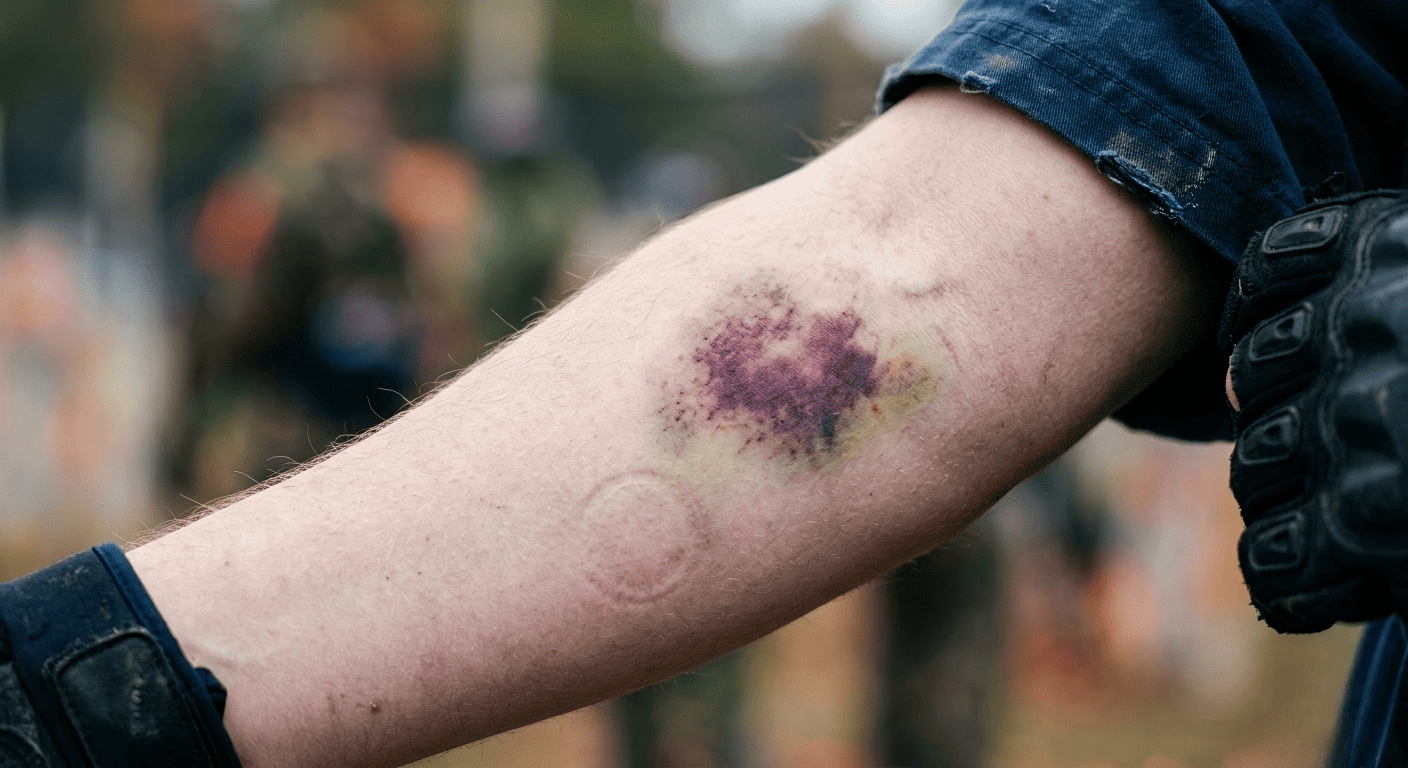
Section 1: The Physics — Why .50 Cal Hurts Less
The answer to “does it hurt?” starts with physics, not opinion. Kinetic energy — the energy a moving object delivers on impact — is the measurable quantity that directly determines pain intensity. The formula is straightforward:
Kinetic energy is calculated as:
KE = ½ × m × v²
Where KE = kinetic energy (joules), m = mass of the paintball (kg), v = velocity at impact (m/s).
Key data points for comparison at standard field velocities:
.68 cal paintball: mass ≈ 3.0–3.2 g, velocity ≈ 280–300 fps (85–91 m/s) → KE ≈ 11–13 joules
.50 cal paintball: mass ≈ 1.25–1.35 g, velocity ≈ 220–250 fps (67–76 m/s) → KE ≈ 4–5 joules
The .50 cal delivers approximately one-third the kinetic energy of a standard .68 cal at typical field settings. This is not a marginal difference — it is a structural, physics-governed reduction in impact energy. Lab testing confirms .50 cal transfers approximately 5 joules versus 13+ joules for .68 cal.
Two independent variables drive this reduction. First, mass: a .50 cal paintball weighs approximately 1.25 grams — less than half the 3.0 gram weight of a .68 cal ball. Since kinetic energy scales linearly with mass, this alone reduces impact energy by more than half. Second, velocity: .50 cal markers operate at 220–250 fps rather than the 280–300 fps of standard play. Since KE scales with velocity squared, even a modest velocity reduction produces a meaningful energy decrease.
The combined effect of reduced mass and reduced velocity produces the one-third impact ratio consistently observed across field testing. This is physics — it cannot be marketing-adjusted or exaggerated. The reduction is real, measurable, and reproducible.
Impact energy at typical field operating velocities. Source: Action Packed Paintball field testing.
Section 2: What Does It Actually Feel Like?
Physics gives us the numbers. Player experience tells us what those numbers mean in practice. Most players describe standard .68 cal paintball as a firm rubber band snap — sharp, immediate, and fading within seconds. Through protective clothing, that sensation drops to a light flick. Through padding, it is barely perceptible.
.50 cal low impact paintball at one-third the energy registers for most players as something between a light tap and nothing at all, depending on where they are hit and what they are wearing. Welts are rare. Bruises are essentially eliminated with proper protective gear. Players who expected pain frequently report surprise — not at how much it hurt, but at how little.
.50 Cal — With Gear
A light tap or flick sensation. Most players stop noticing hits within minutes as adrenaline takes over. No welts. No bruising. Safe for ages 6 and up.
.68 Cal — With Gear
A firm sting that fades within seconds. Small welts possible on bare skin or thin clothing. Uncomfortable for pain-sensitive players but manageable for most adults.
.68 Cal — Without Gear
A sharp, stinging impact. Welts and small bruises likely. This is the scenario that creates negative first impressions and deters repeat play.
💡 The Gear Multiplier
Protective equipment is the other half of the pain equation for both calibers. A proper full-face mask, padded vest, and gloves transform the .50 cal experience into essentially painless. Even for .68 cal, good gear makes the difference between welts and a mild sting. Field operators who invest in quality rental gear for their .50 cal program amplify its marketing message significantly: “It barely hurts — and here’s the gear that guarantees it.”
Section 3: Who Is .50 Cal For? The Four Audiences Fields Are Missing
This is where the conversation shifts from physics to business. Every paintball field loses bookings daily to a single sentence: “I don’t want to get hurt.” The .50 cal program exists precisely to eliminate that sentence — and with it, recover a substantial portion of the revenue that fear of pain costs the industry.
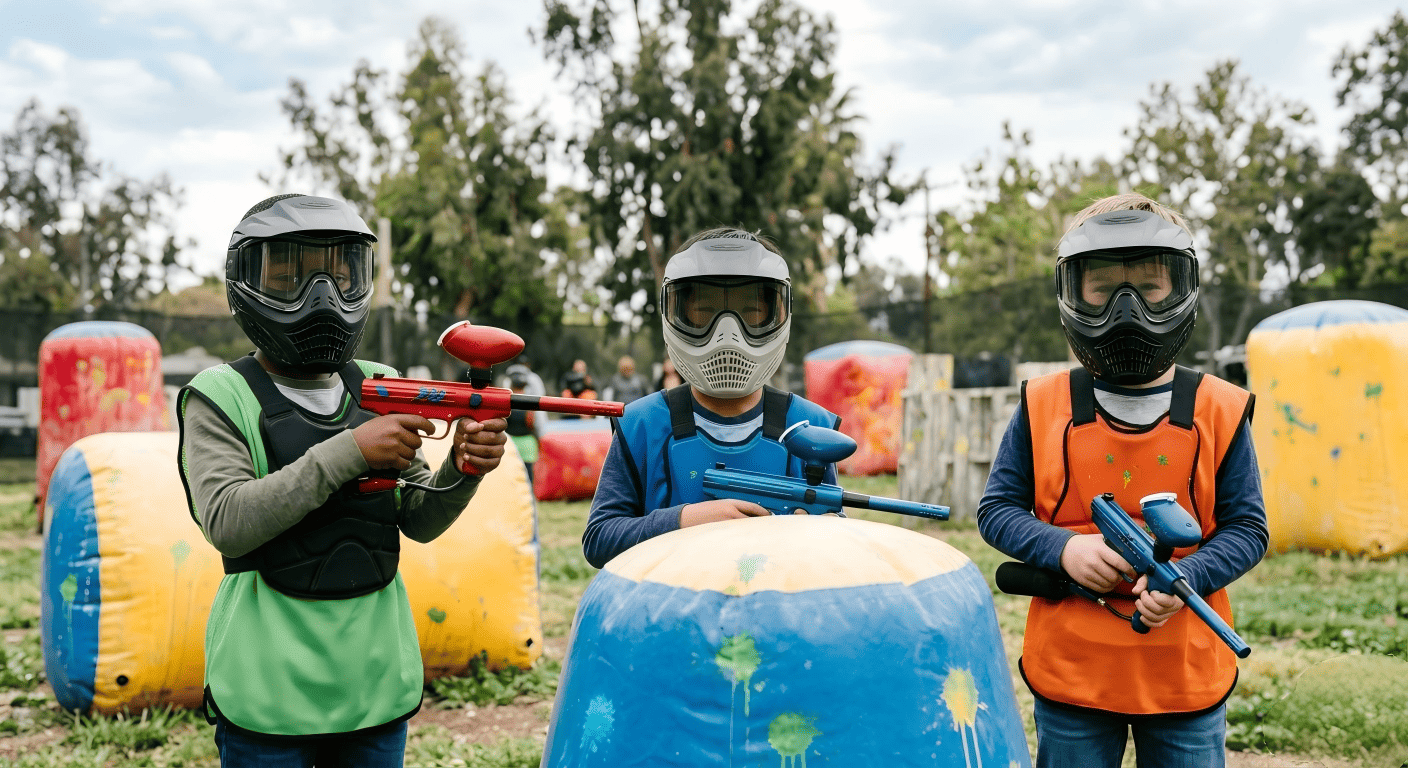
The #1 reason people decline paintball invitations is not cost, not distance, not inconvenience. It is the fear of pain. .50 cal removes that barrier entirely.
Children (6–12)
Parents who refused to bring younger children to standard paintball book confidently with .50 cal. Birthday parties and youth group events become viable. Birthday celebrations are now the leading booking purpose in the global paintball field market.
Women & Mixed Groups
Mixed-gender groups where women decline the standard game convert to bookings with low impact. Corporate team-building events — a high-value segment — become fully inclusive without opt-outs.
First-Time Adult Players
Adults curious about paintball but deterred by reputation. A low-impact first experience creates loyal returning players who eventually graduate to standard play — a long-term customer acquisition strategy.
Families
A family where parents play standard and kids play .50 cal on the same day is a significantly higher-revenue booking than a single group choosing one format. Multi-format days unlock this.
The global paintball field service market was valued at $219 million in 2024 and is projected to reach $285 million by 2030, growing at 4.4% CAGR. Low-impact paintball for younger players is explicitly identified as one of the primary growth drivers, enabling fields to host birthday parties, family packages, and youth summer camps that attract a steady stream of new players.
Fields that offer diverse experiences — including low-impact formats — attract more players more consistently. Adding a .50 cal program does not compete with your standard revenue — it creates new revenue from customers who would otherwise never book.
Section 4: .50 Cal vs .68 Cal — The Complete Operator Comparison
| Factor | .50 Cal — Low Impact | .68 Cal — Standard |
|---|---|---|
| Impact energy | ≈ 4–5 joules | ≈ 12–14 joules |
| Pain level (with gear) | Minimal — light tap | Moderate sting, fades quickly |
| Welt / bruise risk | Essentially zero with gear | Possible on exposed skin |
| Suitable minimum age | 6 years old and up | Typically 10–12+ years |
| Market reach | Families, women, corporates, beginners, youth | Adult players, competitive, experienced |
| Velocity (typical field) | 220–250 fps | 280–300 fps |
| Range and accuracy | Shorter range; adequate for recreational play | Longer range; standard for competition |
| Equipment compatibility | Requires dedicated .50 cal markers | Works with all standard rental markers |
| Paintball cost per unit | Generally lower per ball | Standard pricing |
| Repeat booking rate | Higher — removes barrier to return | Standard — some players put off by pain |
| Premium pricing justification | Yes — new market segment, unique positioning | Standard market rate |
Section 5: Common Questions — Answered Honestly
Is .50 cal completely painless?
Completely painless? Not technically — but functionally, for the overwhelming majority of players with proper protective gear, yes. Most people will not feel pain at all during active gameplay, because adrenaline and the excitement of the game override the very mild sensation of a .50 cal hit. The few players who do notice a hit describe it as a light tap — nothing that causes them to wince, stop, or reconsider playing again.
Can kids play .50 cal paintball safely?
Yes. Low impact paintball with .50 cal is designed for players as young as 6 years old when combined with appropriate full-face protection and age-appropriate supervision. The impact energy is comparable to a light rubber band snap — well below any threshold of injury risk. Parents who would never bring children to standard paintball book .50 cal confidently once the energy numbers are explained to them.
Does the smaller ball affect the gameplay experience?
For recreational play — which is what most field customers engage in — the difference is minimal in practice. Range is slightly shorter, which actually tends to make games feel more dynamic and engaging at closer distances. The strategy, the teamwork, the adrenaline, and the satisfaction of marking an opponent are identical. What .50 cal removes is the pain. What it keeps is everything that makes paintball worth playing.
Can players use .50 cal in .68 cal markers?
No. The two calibers require dedicated, incompatible equipment. A .50 cal ball in a .68 cal marker will not feed correctly, will not fire consistently, and will likely roll forward without propulsion. Fields offering both formats must maintain separate rental fleets for each caliber. This is the primary capital consideration when evaluating a .50 cal program — not a deterrent, but a real investment to plan for.
⚠️ One Caution: Gear Still Matters for .50 Cal
While .50 cal significantly reduces impact energy, it does not eliminate the requirement for proper protective equipment. A full-face mask is non-negotiable at any caliber — eye and dental safety standards apply regardless of ball size or velocity. Never allow players onto a .50 cal field without a properly fitted, full-coverage paintball mask. The “low impact” label refers to body impact energy, not elimination of all safety requirements.
Section 6: How to Use This Information to Grow Your Field
Understanding .50 cal’s physics and player experience is only valuable if it translates into how your field communicates and books. Here is how to turn this knowledge into revenue:
Answer the Pain Question Before It’s Asked
- Add a dedicated “Low Impact Paintball” page to your website that leads with the joule comparison and age-suitability information. Parents researching for their children want numbers, not just reassurance.
- Train staff to answer “does it hurt?” with the physics-backed explanation: “Our low impact option has about one-third the impact energy of standard paintball — most players compare it to a light tap through clothing.”
- Use player testimonials — especially from women and parents — on your social media and booking confirmation emails. First-hand experience from the exact demographic a prospect belongs to is the most persuasive content possible.
Position .50 Cal as an Upgrade, Not a Consolation
- Price .50 cal at a slight premium over standard play — it is a superior experience for its target audience, not a lesser one. Premium positioning justifies the equipment investment and signals quality.
- Offer family packages that combine adult standard play with junior .50 cal on the same day — maximizing per-booking revenue and creating a memorable shared experience.
- Target corporate event planners explicitly: “Everyone participates — no opt-outs.” The team-building market values full inclusion, and .50 cal is the product that delivers it.
Make the First Experience Excellent
- Invest in quality protective gear for your .50 cal fleet — padded vests, proper-fit masks, and gloves. The gear amplifies the “it barely hurts” experience that generates word-of-mouth.
- Brief .50 cal groups explicitly at the start: “You may feel a light tap when hit — that’s it. Focus on the game.” Setting accurate expectations prevents any hit from being a surprise.
- Collect post-session feedback and encourage online reviews immediately after low-impact sessions — these customer voices are your most effective marketing for the next hesitant group.
✅ The Bottom Line for Field Owners
Does .50 cal hurt? At one-third the impact energy of standard paintball, the honest answer is: barely, and usually not at all with proper gear. That answer — honest, physics-backed, and communicated confidently — is worth more to your business than any discount or promotion. It converts the hesitant into the booked. It turns the “I don’t want to get hurt” call into a group session on your field. And it opens your revenue to segments — families, youth groups, women, first-timers, corporate teams — who were never going to say yes to standard paintball, no matter how well you ran your field. The physics are on your side. Use them.