
Can You Refrigerate Paintballs?
The complete science-backed answer — what cold actually does to the gelatin shell and PEG fill, when refrigeration helps, when it destroys, and what field operators should do instead.
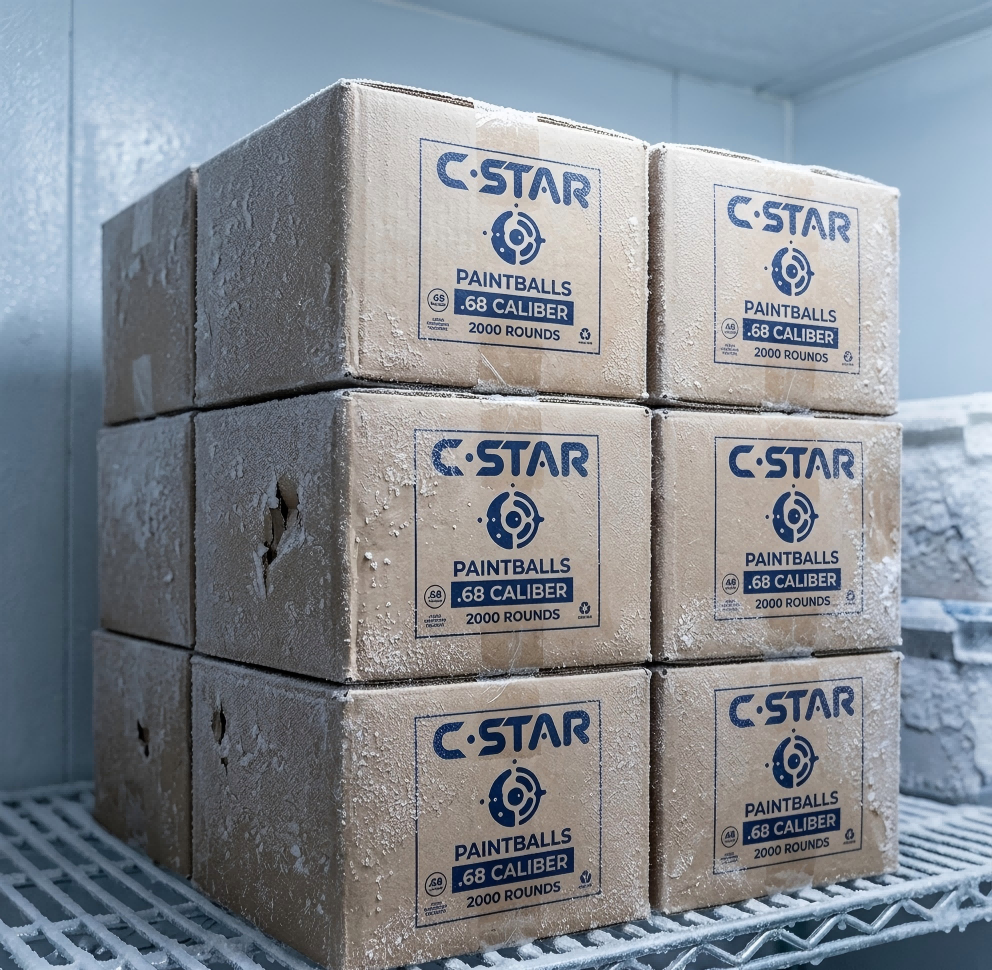
“Should I keep my paintballs in the fridge?” is one of the most searched paintball storage questions online — and one of the most misunderstood. Players assume that cold preserves paint. Field operators worry that summer heat is ruining their stock and wonder if refrigeration is the answer. Importers dealing with overheated shipments think chilling might “restore” damaged balls. The reality is more precise, and more important, than a simple yes or no.
Section 1: What Cold Temperature Does to a Paintball — The Science
To understand why refrigeration is a double-edged tool, you need to understand how cold affects the two structural components of every paintball: the gelatin shell and the PEG-based fill. They respond to cold differently, and both responses work against you when taken too far.
1a. The Gelatin Shell: Glass Transition and Brittleness
The outer shell of a quality paintball is a gelatin polymer — the same protein material used in pharmaceutical capsules and confectionery. At room temperature, gelatin behaves as a viscoelastic solid: it has flexibility, absorbs impact energy, and deforms on target contact to produce a clean break and color mark.
As temperature drops, gelatin undergoes a process well-documented in pharmaceutical polymer science: it approaches its glass transition temperature (Tg) — the point at which a polymer shifts from flexible rubber-like behavior to rigid, brittle glass-like behavior. Below this threshold, the polymer chains lose mobility. The material stops absorbing impact energy and instead fractures.
ACG Pharma’s systematic study of gelatin capsule brittleness confirms that the glass transition temperature of gelatin is directly governed by its moisture content and the presence of plasticizers (glycerin, sorbitol). At the moisture levels maintained in paintball shells (approximately 10–18% water content by analogy with softgel capsule standards per ScienceDirect pharmaceutical capsule research), the practical brittleness threshold for gelatin-glycerin composites occurs somewhere between 45–55°F (7–13°C) — well within standard refrigerator operating range.[1,2]
A PubMed study on gelatin capsule brittleness confirms that moisture loss from the capsule shell is the primary driver of brittleness — and that cold, dry refrigerator air actively removes moisture from gelatin surfaces through desiccation. The result: even sealed paintballs gradually lose shell moisture in a refrigerator environment over extended storage.[3]
Field-level confirmation comes from WARPIG, one of the industry’s oldest technical resources: “Cold air is relatively dry and will pull water from a paintball shell. Paintballs become very brittle in the cold — this causes breakage in the carton, loaders, hopper, and barrel.”
The practical consequence is direct and unambiguous: paintballs removed from a refrigerator and loaded directly into a marker will break inside the barrel, in the hopper, and sometimes simply from handling — before they ever reach a target. The shell has crossed its glass transition threshold. It is no longer a precision sphere engineered to break on impact. It is a brittle capsule that fractures on the first mechanical stress it encounters.
1b. The PEG Fill: Viscosity Changes in Cold
While the gelatin shell turns brittle, the PEG-based fill inside undergoes a separate but equally important transformation: it becomes significantly more viscous — thicker, slower-moving, closer to a paste than a liquid.
Polyethylene Glycol (PEG), the primary fill ingredient in quality paintballs, has a viscosity that is strongly temperature-dependent. At ideal storage temperatures (59–77°F), PEG fill behaves as a free-flowing liquid — it bursts outward on impact, producing the large, visible color mark that signals a hit. At refrigerator temperatures (35–45°F), PEG viscosity increases substantially. As ANSGear’s winter paintball guide notes: “The fill is going to be sludge in the cold — dream on if you think you can shoot through it.”
Shell Effect: Brittleness
Gelatin approaches glass transition temperature. Polymer chains lose mobility. Shell fractures under mechanical stress — in the barrel, hopper, or from handling — before reaching target. Barrel break rate spikes to near 100% from refrigerator temperature.
Fill Effect: High Viscosity
PEG fill thickens significantly in cold. On the rare occasions a cold ball does reach its target, the mark left is smaller, less defined, and may not spread sufficiently for clear hit confirmation. Fill that should splash becomes a slow-release paste.
Performance Effect: Failure
Combined effect: balls break in the marker before firing, or if they survive to target, the brittle shell may shatter on the player’s gear leaving an ambiguous mark. Velocity consistency drops due to diameter changes from shell contraction. Accuracy degrades.
Section 2: The Temperature Spectrum — What Each Zone Means
Understanding where refrigeration sits on the full temperature spectrum helps clarify exactly when and why it causes problems:
A standard household refrigerator operates between 35–45°F (2–7°C). Paintball USA confirms that gelatin shells become brittle below 70°F — meaning refrigerator temperatures are well within the brittleness zone. The refrigerator does not sit near the safe lower boundary of the ideal range. It sits firmly in the danger zone.
A refrigerator keeps food fresh. It keeps paintballs brittle. These are not the same outcome, even though both involve cold.
Section 3: When Refrigeration Is Used — and When It’s Legitimate
Despite the brittleness risk, refrigeration does appear in real-world paintball practice — and not always irrationally. Understanding the specific, narrow circumstances where it can serve a purpose helps field operators and players make informed decisions rather than blanket rules.
Legitimate Use Case: Short-Term Hot Weather Emergency Storage
In regions with extreme summer heat — where ambient temperatures routinely exceed 95°F (35°C) and no air-conditioned storage is available — a refrigerator can serve as a short-term alternative to leaving paintballs in a hot environment that would cause shell softening, deformation, and sticking. In this specific scenario, refrigerator cold is preferable to the alternative: heat-damaged, deformed paint that is equally unusable.
💡 The Critical Condition: Warm-Up Before Use
If paintballs are removed from a refrigerator for use, they must be returned to room temperature before loading. NR Adventure Park’s cold weather guide recommends placing cold paint in a warmer environment slowly, then testing a few balls before play. The warm-up process should take at least 30–60 minutes at room temperature. Rapid heating (e.g., using a heat gun or microwave) causes condensation inside the shell, leading to misshapen balls and inconsistent performance. Never load paintballs directly from the fridge into a marker.
Legitimate Use Case: Temporary Cooling on Hot Game Days
Some field operators use insulated coolers without ice to keep paintballs at a stable temperature during hot outdoor sessions — preventing heat-driven softening between groups. This is not true refrigeration — a cooler without ice maintains a temperature closer to 70–80°F on a hot day, which is within or near the safe range. AC Paintball notes: “Bring a small insulated cooler, warmed to room temperature, to keep paintballs in before gameplay.” The key word is “warmed” — the cooler is used for temperature stability, not refrigerator-level cooling.
What Refrigeration Cannot Do
- It cannot reverse heat damage. Paintballs that have softened, deformed, or stuck together from heat exposure will not recover their original shape and hardness through refrigeration. The gelatin structure has already changed.
- It cannot restore humidity damage. Paintballs that have swollen from moisture absorption, or developed dimples and flat spots, will not be corrected by cold. These are permanent physical changes.
- It cannot extend shelf life significantly. The cold slows microbial activity but also desiccates the shell over time. Long-term refrigerator storage is not more effective than a properly climate-controlled room at 59–77°F — and carries the added brittleness risk.
- It cannot improve break rate on target. This is a persistent myth. Cold paintballs do not break more cleanly on target — they break more easily in the barrel and hopper, and leave smaller, less defined marks when they do reach a player.
Section 4: Debunking the Myths — Cold Paintballs and Break Rate
One of the most persistent myths in paintball player communities is the idea that refrigerating paintballs improves their break rate — the likelihood that a ball breaks cleanly on target contact rather than bouncing off. The reasoning goes: colder = harder shell = breaks more easily on impact. The reality is more nuanced and contradicts this assumption.
🚨 Zero Tolerance: Freezing Paintballs
Intentionally freezing paintballs before play is not a performance hack — it is a safety violation. A ball that has been subjected to freezer temperatures and then somehow fires will not break in a normal splatter pattern. It will deliver concentrated, hard impact that causes injury. No reputable field permits play with refrigerator- or freezer-cold paintballs fired directly without warm-up. This is not a gray area.
Section 5: The Correct Protocol — What to Do Instead
For the overwhelming majority of field operators and players, the answer to “can I refrigerate paintballs?” is: you don’t need to, and you shouldn’t unless forced to by extreme heat with no alternative. Here is what actually protects paintball quality:
| Situation | Wrong Approach | Correct Approach |
|---|---|---|
| Summer heat — no AC storage | Leave in hot warehouse / fridge | Insulated cooler (no ice) + ventilated shade |
| Game day hot weather | Load directly from cooler/fridge | Bring to room temp 45–60 min before play, load just before game |
| Long-term bulk storage | Refrigerate to “preserve” | Climate-controlled room: 59–77°F, 40–50% RH, sealed, dark |
| Heat-damaged soft paint | Refrigerate to “harden” | Cannot be reversed — document, test quality, discard if performance-critical |
| Cold winter storage | Unheated shed / garage | Heated indoor space. Keep pods & hoppers under jacket during play |
| Improving break rate | Refrigerate to harden shell | Choose premium PEG-based paint; match bore to paint diameter; maintain ideal temp |
| Field-day between sessions | Leave open bags in sun or heat | Reseal bags; store in shaded insulated bag or air-conditioned space between groups |
The Field Operator’s Real Tools for Temperature Management
- Climate-controlled storage room: The only real solution for bulk stock. Target 59–77°F and 40–50% relative humidity. This is more effective than any cold storage approach and carries zero brittleness risk.
- Insulated coolers (without ice) for game-day transport: Maintains stable moderate temperature between sessions on hot days. Not refrigerator-cold — just buffered from peak summer heat.
- Portable hygrometer and thermometer: Know the actual conditions in your storage area. Do not assume — measure. A $15 digital hygrometer is the most cost-effective paintball quality tool you can buy.
- First-in, first-out (FIFO) stock rotation: Older stock gets used first, regardless of storage quality. Aging amplifies the effect of any marginal storage conditions.
- Pre-game quality check (3-test): Visual (round, no dimples), touch (firm but not brittle), and throw test (breaks cleanly on hard surface from waist height). If a ball from the batch fails any test, do not load the batch.
- Inform distributors of storage requirements: Your quality chain extends to everyone who handles your stock. Distributors storing paintballs in uncontrolled warehouses or vehicles compromise the product before it reaches you.
✅ The Complete Answer: Can You Refrigerate Paintballs?
Technically yes — with strict conditions. A refrigerator can serve as a short-term emergency storage when extreme heat leaves no alternative. But paintballs removed from a refrigerator must be brought to room temperature for 45–60 minutes before play. They must never be loaded directly from refrigerator temperature. They must be stored sealed to minimize shell moisture loss. And refrigeration must never be confused with an improvement in paintball performance, preservation, or break rate — it is none of those things.
The better answer for field operators and importers: you should never be in a position where a refrigerator is your best paintball storage option. A climate-controlled storage room at 59–77°F (15–25°C) with 40–50% relative humidity protects quality better than any cold storage — without brittleness, without required warm-up time, and without the risk of destroyed stock from someone forgetting to warm the balls up before play.
Scientific References
- Brittleness in Gelatin Capsules: Assessing the Gelatin Polymer. ACG Pharma / Pharma-Trends, 2019. pharma-trends.com
- Capsule shell brittleness as a function of relative humidity. ScienceDirect / International Journal of Pharmaceutics, 1989. sciencedirect.com
- Gelatin capsule brittleness: moisture transfer between capsule shell and content. PubMed / Pharm Dev Technol, 1998. pubmed.ncbi.nlm.nih.gov
- Mechanical properties and glass transition in crosslinked gelatin. Colloid and Polymer Science / Springer, 1997. link.springer.com
- Paint Management in Cold Weather. NR Adventure Park, 2024. nradventurepark.com
- Store Paintballs: Environmental Effects. WARPIG Paintball Information Guide. warpig.com
![cstar logo -[paintball]](https://cspaintballs.com/wp-content/uploads/2024/10/cropped-cropped-c-star-logo.webp)