
What Size Is a Standard Paintball?
The complete caliber guide for field operators — from standard specifications to why “0.68” is never quite exactly 0.68, and what that means for your equipment and your business.
If you’ve ever received a supplier quote listing “.68 cal” and “.50 cal” without explanation, wondered why paintballs are jamming your rental markers after a batch switch, or considered adding a low-impact paintball program to your field — this guide is for you. Paintball size is one of the most misunderstood specifications in field operations, and getting it right protects your equipment, your throughput, and your customers’ experience.
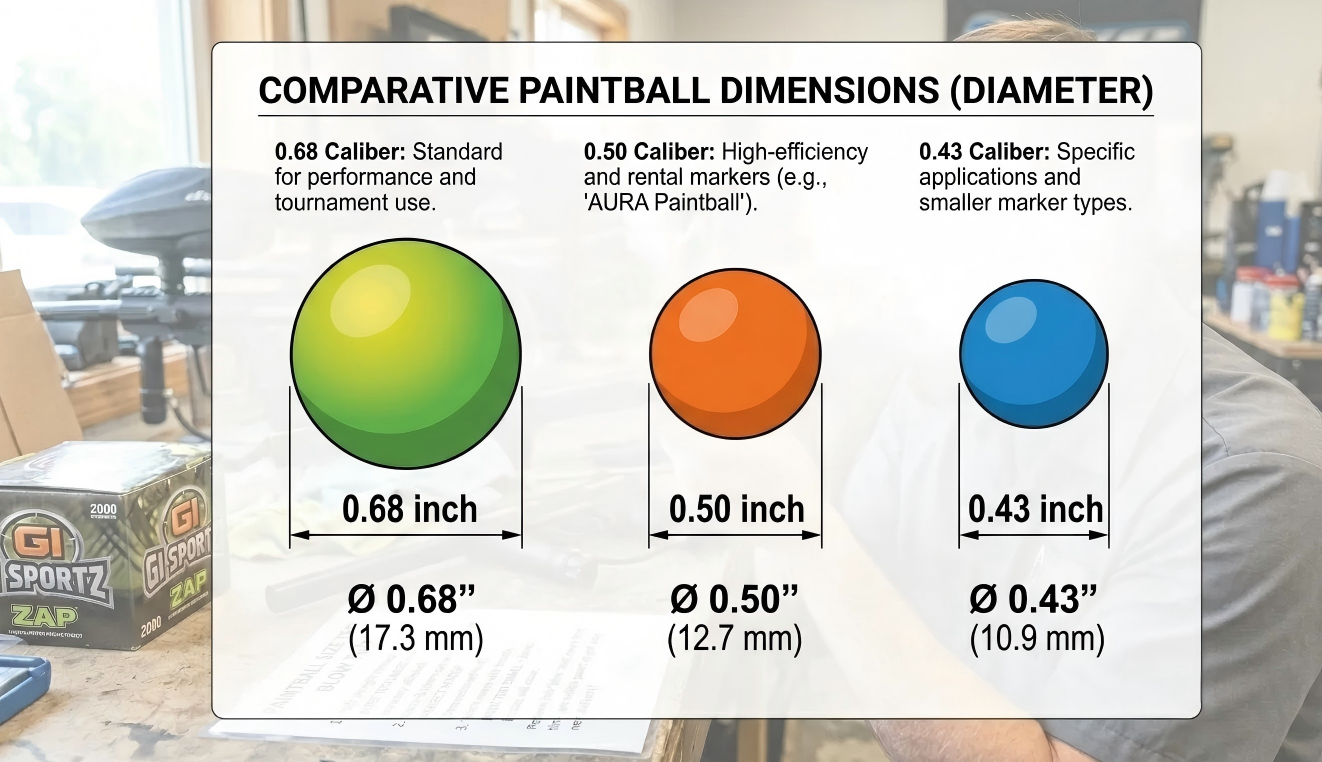
The standard paintball size is .68 caliber — approximately 0.68 inches (17.3 mm) in diameter. It is the industry-wide standard used in the overwhelming majority of recreational fields, rental markers, and competitive play worldwide. Two smaller calibers exist: .50 cal (low-impact, family programs) and .43 cal (law enforcement/training use). Each caliber requires dedicated, compatible equipment — they are not interchangeable.
The Three Paintball Calibers: What Every Field Owner Must Know
Paintball caliber refers to the diameter of the ball in inches. The number is not a weight rating or a pressure specification — it is a measurement of physical size. Here are the three calibers in active commercial use:
- Dominant format worldwide
- All competitive/tournament play
- Widest equipment compatibility
- Largest paint splatter on impact
- Shot at ~280–300 fps
- Most rental markers use this caliber
- Family / junior programs
- Significantly less sting on impact
- Requires dedicated .50 cal markers
- Shorter effective range
- Shot at ~250 fps or lower
- Growing segment for field diversification
- Law enforcement / military training
- Rarely seen on recreational fields
- Requires specialist markers
- Not for general public sessions
- Very limited retail availability
- Not a field diversification option
🔑 Field Operator’s Key Rule
Calibers are not interchangeable. A .50 cal paintball will not function in a .68 cal marker — it will either fail to feed, roll forward without propulsion, or fire inconsistently. Each caliber requires its own dedicated marker, hopper, and barrel system. Mixing calibers with incompatible equipment is the most common cause of unexplained marker jams and broken paint in rental fleets.
Why “0.68” Is Never Exactly 0.68 — The Manufacturing Reality
Here is something most field operators discover only after a frustrating round of barrel jams or inconsistent shot patterns: the “.68 cal” label on a bag of paintballs is a nominal designation, not a precision measurement. The actual diameter of individual paintballs within a single batch can vary meaningfully — and understanding why is essential operational knowledge.
Paintballs are not machined. They are grown — from liquid to gel to solid — and every step of that process introduces natural size variation.
The Production Process: Why Precision Is Inherently Limited
Unlike airsoft BBs, which are manufactured through injection molding of thermoplastic polymers — a process that produces highly consistent, repeatable dimensions within ±0.01 mm tolerances — paintballs are produced through softgel encapsulation: a process more analogous to pharmaceutical capsule production than precision component manufacturing.
The process works as follows: liquid gelatin sheets are formed between two rotating dies, fill material is injected, and the capsule is sealed and cut — all in a continuous, high-temperature, high-humidity environment. The balls then undergo two drying stages — first in a tumble dryer (which also helps round them), then in climate-controlled drying rooms for 24–48 hours — before final sorting.
Gelatin is a protein polymer with a fundamentally different physical behavior than plastic. It is hygroscopic — it absorbs and releases moisture from the surrounding environment. It is viscoelastic — it deforms under pressure and partially recovers. Its dimensional behavior is strongly temperature-dependent: a paintball that measures .685″ in a cool, dry warehouse may measure .689″ after sitting in a humid field storage room for two hours. High moisture causes gelatin shells to soften and swell; hot, dry conditions cause shrinkage and brittleness. This is not a quality control failure — it is the physical chemistry of the material itself.
The practical result: within the “.68 caliber” family, individual paintballs typically measure anywhere from .682 to .693 inches, depending on the manufacturer, the batch, and the storage conditions before use. Premium tournament-grade paint is sorted more tightly (typically .684–.688) and rejected at a higher rate; recreational and field-grade paint accepts wider tolerances.
| Factor | Airsoft BBs | Paintballs (.68 cal) | Field Impact |
|---|---|---|---|
| Manufacturing process | Injection molding (thermoplastic) | Softgel encapsulation (gelatin) | Paintballs inherently less precise |
| Size consistency | ±0.01 mm typical | ±0.1–0.3 mm typical | Barrel bore matching matters |
| Temperature sensitivity | Very low | High — swells in heat/humidity | Storage conditions affect performance |
| Humidity sensitivity | Negligible | Significant — absorbs moisture | Batch-to-batch variation expected |
| Shape consistency | Near-perfect spheres | Slight oval variation common | Out-of-round balls affect accuracy |
| Shelf life | Years if stored dry | Months; degrades with heat/humidity | Rotate stock; avoid summer storage spikes |
Paint-to-Barrel Matching: The Operational Consequence
Because paintballs are not precisely sized, the relationship between your paintball’s actual diameter and your marker’s barrel bore diameter is one of the most important — and most overlooked — variables in rental fleet performance. Most standard paintball barrels are produced with bore sizes around .689–.691, which works well with the majority of field-grade paint. But when that relationship breaks down, the results are immediately visible in your operations:
- Ball too small for bore (.682 ball in .691 barrel): Air escapes around the ball during firing. Velocity is inconsistent. Shots curve or fall short. Players complain that “the gun isn’t working.”
- Ball too large for bore (.693 ball in .689 barrel): Paintball is squeezed as it feeds, breaking inside the barrel. Marker jams with paint. Staff time consumed cleaning markers between groups. Customer experience disrupted.
- Swollen paintballs from heat/humidity exposure: Paintballs stored in a hot vehicle or non-climate-controlled space expand. Even a ball that measured correctly in the morning may jam markers by afternoon on a hot day.
✅ The Field Operator’s Bore Test — 10 Seconds Per Marker
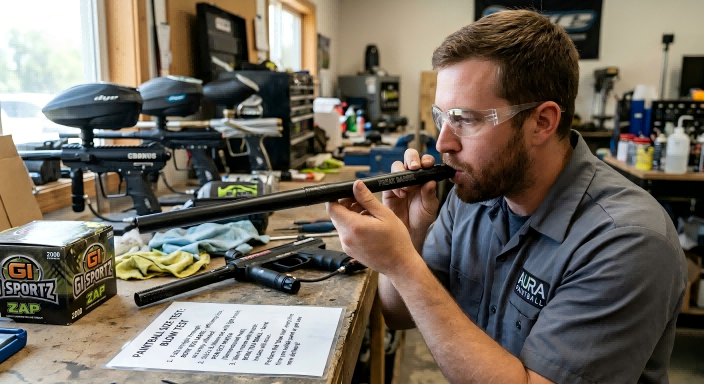
Drop a paintball from your current batch vertically down each rental marker’s barrel. Falls straight through: bore too large — efficiency loss, accuracy affected. Drops and sticks, can be blown out with a light breath: perfect match. Won’t move with a breath: bore too small — barrel breaks will occur. This “blow test” is the fastest, most reliable way to verify paint-barrel compatibility — perform it every time you switch to a new paint batch or receive a new delivery.
The .68 vs .50 Decision for Field Owners
The most common caliber decision facing field operators today is whether to introduce a .50 caliber low-impact program alongside their standard .68 cal offering. This is a business decision as much as a technical one. Here is the operational reality:
| Consideration | .68 Cal (Standard) | .50 Cal (Low Impact) |
|---|---|---|
| Market reach | Adult players, competitive, experienced | Families, children 8+, corporate groups, first-timers |
| Equipment investment | Already in your rental fleet | Separate set of dedicated .50 cal markers required |
| Paint compatibility | Wide supplier options, bulk pricing available | Fewer suppliers; may command slight price premium |
| Cleaning & maintenance | Standard protocol | Same protocol — no additional complexity |
| Customer hesitation removal | Some adults/parents decline due to pain concern | Eliminates the #1 reason first-timers say no |
| Revenue per session | Standard | Premium pricing justified — new market segment |
💡 Field Business Insight
The most significant commercial argument for adding .50 cal is that it converts refusals into bookings. Research consistently shows that the primary reason adults decline paintball invitations is fear of pain — particularly for corporate events and family occasions. A low-impact option doesn’t compete with your standard program; it captures a customer segment that would otherwise not come at all. The equipment investment pays for itself in new group bookings within a single season for most medium-to-large fields.
Practical Storage and Handling: Protecting Size Consistency
Because paintball size is sensitive to temperature and humidity, how you store your paintball stock directly affects marker performance, barrel-break rates, and staff cleaning time. Temperature and humidity control during storage is as important as the quality of the paintball itself.
- Store in a cool, dry environment: Ideal storage temperature is 60–75°F (15–24°C) with moderate humidity. Avoid garages, outdoor sheds, or any space that experiences temperature swings.
- Never store in vehicles overnight: Vehicle interiors can reach 130°F+ in summer. A few hours at that temperature causes measurable swelling and shell softening.
- Rotate stock — first in, first out: Paintballs have a shelf life of approximately 3–6 months in good conditions. Older stock that has absorbed moisture becomes oversized and jam-prone.
- Open cases only when needed: Paintballs begin absorbing ambient humidity as soon as the sealed bag is opened. For high-humidity climates, open only the quantity needed per session.
- On hot days, pre-test your batch: Run the blow test on your rental markers at the start of each operating day when summer temperatures are high. Paintballs that pass the morning test may fail by midday if stored in sun-exposed areas.
⚠️ The Supplier Switching Risk
Switching to a new paintball supplier — even staying within the same .68 caliber — can change the actual diameter of your stock. Different manufacturers produce paint at different nominal sizes within the .68 family (.682, .685, .687, .689, .692 are all in commercial use). Always run the bore test when onboarding a new supplier’s paint, and check compatibility with your rental fleet before committing to a bulk order. A mismatch between your new paint and your existing barrel bores is the most common cause of unexpected barrel-break spikes after a supply switch.
The Bottom Line: Size Is Simpler Than It Looks — Mostly
For the vast majority of field operations, the answer to “what size is a standard paintball?” is simply: .68 caliber. That is the size your rental markers accept, the size your paint supplier defaults to, and the size every player has used on every recreational field for the past three decades.
The nuance — and the operational value — lies in understanding that “.68 cal” is a family of sizes, not a fixed point. Gelatin’s physical properties make perfect consistency impossible, and environmental conditions make that variation dynamic. The field operators who understand this are the ones who never get caught by a summer afternoon of barrel jams, who switch suppliers without disruption, and who know exactly why their markers are performing differently on a humid Friday versus a dry Tuesday.
✅ The Field Owner’s Caliber Checklist
Standard operations: Stock .68 cal from a verified PEG-based manufacturer. Run the bore test with every new batch. Store in climate-controlled conditions. Rotate stock. | Considering low-impact: Budget for a dedicated .50 cal marker fleet — they cannot share equipment with your .68 cal program. Evaluate the family/corporate booking upside against the capital investment. | Troubleshooting jams: Before assuming marker malfunction, check paint-to-barrel fit. Swollen or oversized paint is the leading cause of barrel breaks in rental fleets. | Switching suppliers: Always bore-test the new batch before bulk ordering. Size varies between manufacturers even within the same caliber designation.