
The Ultimate Paintball Beginner’s Guide 2026: Gear, Safety & Pro Tips
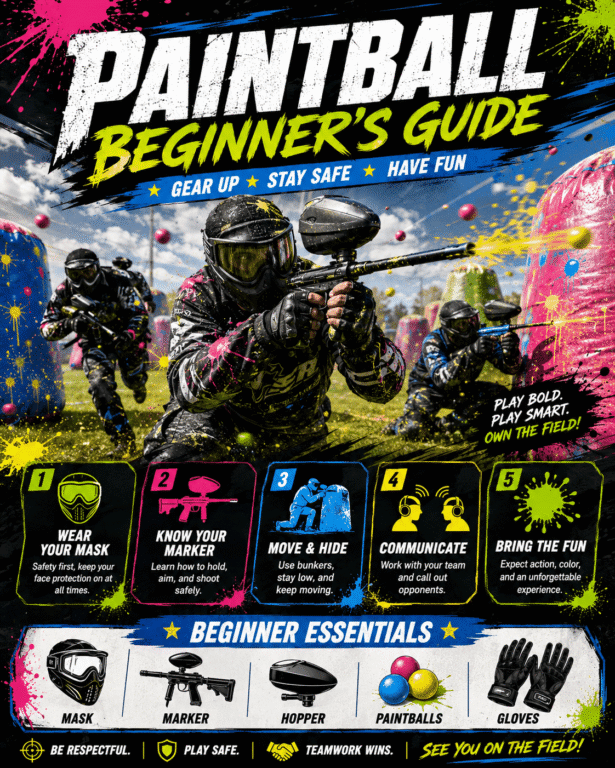
Everything you need to know to start playing paintball — from choosing your first paintball marker to mastering your first speedball or woodsball match. No fluff, just real advice from people who’ve been shot thousands of times.
So you want to play paintball. Maybe you saw it on YouTube. Maybe your friends dragged you into it. Maybe you’re looking for the best paintball beginner’s guide that actually tells you what matters — not just a rehash of Wikipedia paragraphs. You’re in the right place.
This paintball guide covers what beginners actually need: the right paintball gear, non-negotiable paintball safety rules, how to pick your first paintball marker, and what to expect the moment you step onto a paintball field. I’ve played tournament and scenario paintball for over a decade. I’ve refereed games. I’ve seen every rookie mistake in the book — and I’m going to help you skip most of them.
What Is Paintball? A Quick Overview
Paintball is a competitive team shooting sport where players eliminate opponents by hitting them with spherical, gelatin-shelled paintballs fired from a compressed-air-powered device called a paintball marker (often called a paintball gun). Games range from casual weekend rec-ball to professional tournament paintball events streamed live on the National Xball League (NXL) circuit.
Invented in the early 1980s, paintball has grown into a global sport with millions of participants. The modern game spans multiple formats — the hyperkinetic speedball played on symmetrical turf fields, the immersive woodsball set in natural terrain, narrative-driven scenario paintball events that can draw thousands of players for weekend-long campaigns, and milsim paintball (military simulation) which uses realistic markers and tactical gear for those who want an authentic combat-sport experience.
Don’t overthink which format to start with. Most paintball fields near me searches will return local fields that offer both rec-ball (woodsball-style) and speedball. Show up, rent gear, and try whatever’s running that day. You’ll figure out what you like after a few outings.
Types of Paintball Games: Find Your Format
Not all paintball is the same. Each format demands different skills, gear, and mindsets. Here’s what you’re walking into:
| Format | Field Type | Game Length | Players | Vibe |
|---|---|---|---|---|
| Speedball | Flat turf with inflatable bunkers | 3–7 min | 3v3 to 5v5 | Fast, competitive, tournament-style |
| Woodsball | Forest / natural terrain | 15–45 min | 10v10 up to 50v50 | Tactical, immersive, rec-friendly |
| Scenario Paintball | Large themed fields | Hours to full weekend | Hundreds to thousands | Narrative-driven, objective-based |
| Milsim Paintball | Urban / woodland MILSIM fields | Varies | Squad-based | Military realism, mag-fed markers |
| Mag-Fed Paintball | Any field type | Varies | Small squads | Limited ammo, realism-focused |
Speedball is the ESPN side of paintball — bright jerseys, loud markers, split-second decisions. Matches are short and intense. If you’ve ever watched tournament paintball on YouTube, this is it. Woodsball is what most people picture when they hear “paintball” — sneaking through trees, communicating with hand signals, longer firefights. Scenario paintball events like Oklahoma D-Day or Living Legends are full-blown productions with storylines, generals, and objectives that unfold over an entire weekend.
- If you like fast action and competition → Speedball
- If you prefer strategy and immersion → Woodsball
- If you want the full experience in one day → Rec-ball at a local paintball field (mixes elements of both)
Essential Paintball Gear: The Complete Breakdown
Walk into a paintball gear shop or browse online and you’ll drown in options. As a beginner, you only need to understand four core pieces of paintball equipment. Everything else is a nice-to-have.
1. Paintball Marker (The Gun)
Your paintball marker is your primary tool. Modern markers are broadly divided into mechanical paintball markers (no batteries, reliable, easier to maintain) and electronic paintball markers (battery-powered, faster firing modes, tournament-ready). For a beginner, mechanical markers are overwhelmingly the better choice — they’re cheaper, tougher, and teach you fundamentals without the crutch of high rates of fire.
Top beginner paintball markers in 2026:
- Planet Eclipse Emek — The gold standard. Gamma Core bolt system, nearly indestructible, and an upgrade path that grows with your skill. Widely considered the best paintball marker for beginners.
- Tippmann Cronus — Budget-friendly, milsim styling, built like a tank. Perfect if you’re primarily interested in woodsball.
- GoG eNMEy — Smooth pneumatic operation at a great price point. Lightweight and snappy.
2. Paintball Mask — Do Not Cheap Out Here
Your paintball mask is the single most important piece of paintball protective gear you will buy. A fogged lens mid-game turns you into a liability. A cracked lens is dangerous. Invest in a mask with a thermal (dual-pane) lens — it prevents fogging in nearly all conditions.
Recommended paintball masks: Virtue VIO Ascend, Dye i5, JT Proflex, Bunker Kings CMD, HK Army HSTL.
Never remove your paintball mask on the field. Not even for a second. Not even if it fogs. Not even if the game is “over.” Barrel covers go on before masks come off — period. Most paintball eye injuries happen during “safe” moments when someone lifts their mask. ASTM-certified paintball masks are rated to withstand direct impacts at 300+ FPS. Your sunglasses are not.
3. Air Tank — HPA vs. CO2
Paintball markers are powered by compressed gas. Your two options:
- HPA tank (High-Pressure Air) — The modern standard. Consistent pressure regardless of temperature, compatible with all markers. A 48ci/3000psi aluminum tank is the budget entry point; a 68ci/4500psi carbon-fiber HPA tank is the long-term investment.
- CO2 tank — Largely obsolete. Inconsistent in cold weather, can damage electronic markers, and fewer fields fill CO2. Skip this unless your local field specifically requires it.
4. Paintball Hopper (Loader)
The paintball hopper sits on top of your marker and feeds paintballs into the breech. Options:
- Gravity-fed hopper — Simple, cheap, works fine for mechanical markers at moderate rates of fire. The Proto Primo is the best of this type.
- Electronic hopper (force-fed loader) — Uses a motor-driven feed system for consistent feeding at high rates of fire. The Virtue Spire IR2 and Dye LTR are solid choices if you plan to play speedball or upgrade to an electronic marker.
Additional Paintball Gear Worth Having
- Paintball jersey and pants — Purpose-built with padding in impact zones, ventilation, and reinforced knees. Much better than jeans and a hoodie after your third game.
- Paintball pod pack (harness) — Holds spare paint tubes (pods) so you can reload mid-game without walking off the field.
- Knee pads and elbow pads — The ground on a paintball field is often hard-packed dirt, gravel, or turf. Your knees will thank you after a day of diving into bunkers.
- Cleats — Football or soccer cleats. Do not wear running shoes on a paintball field unless you enjoy sliding face-first into a bunker.
- Gloves — Getting shot in the knuckle is memorable in the worst way. Paintball-specific gloves or even lightweight mechanic gloves help enormously.
- Thermal-lens paintball mask (DO NOT SKIP)
- Mechanical paintball marker (Emek / Cronus / eNMEy)
- HPA tank (48ci/3000psi aluminum minimum)
- Gravity-fed hopper or entry-level electronic loader
- Barrel cover (usually included with marker)
- Paintballs (buy at the field — paint doesn’t ship well)
- Loose, dark or camo clothing (if not buying paintball-specific apparel yet)
- Cleats or trail shoes with ankle support
Paintball Safety Rules: The Non-Negotiables
Paintball has an excellent safety record — statistically safer per 1,000 participants than basketball, soccer, and even golf according to ASTM International sports injury data. That record exists because of strict, universal paintball safety rules enforced at every legitimate field.
- Mask on at all times on the field. No exceptions. Ever. Even between games. If the field is live, your mask is on.
- Barrel cover on when off the field. The moment you step out of the netted playing area, your barrel cover (also called a barrel sock or barrel plug) goes on and stays on.
- Chronograph your marker. Every paintball field has a maximum velocity — usually 280–300 FPS (feet per second). You must chronograph (measure and adjust) your marker before play. Shooting hot is grounds for ejection.
- Listen to the referees. Ref commands — “Game on,” “Game over,” “Cease fire,” “Barrel covers on” — are absolute. When a ref says barrel covers on, you stop moving, stop shooting, and put your cover on.
Beyond the iron rules, there’s practical paintball safety that experienced players practice automatically:
- Treat every marker as if it’s loaded. Even when you “know” it’s empty. Even in the staging area.
- Keep your finger off the trigger until you’re on the field and the game is live.
- Inspect paintballs before loading. Cracked or dimpled paintballs can break in your marker and create a mess that takes 20 minutes to clean.
- Stay hydrated. Paintball is more physically demanding than it looks. A full day in a mask and gear under the sun will dehydrate you fast.
Your First Day at the Paintball Field: What to Expect
Searching “paintball fields near me” and showing up can be intimidating. Here’s exactly how a typical day unfolds so there are no surprises.
Arrival and Check-In
Arrive 30 minutes before the posted start time. You’ll sign a waiver (this is standard — paintball is an assumption-of-risk sport), pay your entry and paintball gear rental fee if you’re renting, and buy paintballs. Most fields are field-paint-only (FPO), meaning you must use paintballs purchased on-site. This isn’t a scam — it prevents players from bringing old, brittle, or improperly stored paint that could foul markers or cause safety issues.
The Safety Briefing
Every reputable paintball field begins the day with a mandatory safety briefing covering the rules above. Pay attention. Referees notice who’s listening, and they’ll watch out for the attentive players.
Gearing Up
Rental paintball equipment is basic but functional. Expect a Tippmann 98 Custom or similar mechanical marker, a basic single-pane mask (this is why buying your own thermal mask early is such a good investment), an aluminum HPA or CO2 tank, and a gravity hopper. You’ll also get a rental pod pack with a few tubes of paint.
Rental masks fog. It’s almost a guarantee. If you buy exactly one piece of personal paintball gear before your first outing, make it a thermal-lens mask. It transforms the experience from “I can’t see anything” to “I can actually play the game.” The JT Proflex and Virtue VIO Ascend both retail under $80 and outperform any rental mask by a mile.
Gameplay
Rec-ball games are typically elimination-based — last team standing wins. You’ll play multiple 10–20 minute rounds with breaks in between to reload paint, hydrate, and talk strategy. Referees call hits (paintball breaks that leave a visible mark), settle disputes, and keep things moving. If you get hit, raise your marker or hand, call yourself “out,” and walk to the dead zone with your barrel cover on. Don’t argue hits. Even if you think it bounced. Arguing with refs is the fastest way to get a reputation as “that guy.”
Between Games
Between rounds, head back to the staging area (the safe zone). This is where you reload pods, clean your lens, drink water, and talk about the last game. It’s also where you’ll meet other players and learn — the paintball community is remarkably welcoming to beginners who show respect for the safety rules.
Paintball Field Etiquette: Don’t Be That Rookie
Paintball has an unwritten code. Break it, and you’ll find yourself isolated faster than a rental player wandering into a speedball tournament. Here’s what separates good players from the ones people avoid:
- Call your hits. A paintball that breaks on you and leaves a splat the size of a quarter or larger means you’re out. If it bounces, you’re still in. This distinction is basic paintball knowledge. Wiping hits (trying to clean off a break) is cheating and will get you banned from fields.
- Don’t overshoot. Once a player is visibly hit and calling themselves out, stop shooting. One or two bonus balls happen in the heat of the moment. Putting 10 extra rounds into someone who’s already walking off is called overshooting and it’s the cardinal sin of paintball.
- Help new players. If you see a rental player struggling with their paintball marker, help them. The sport grows when experienced players are generous with their knowledge.
- Respect the chrono. Fields chronograph at 280–300 FPS for a reason. Shooting over the limit is dangerous and disrespectful.
- Leave the staging area clean. Pick up your spent pods, empty paint boxes, and trash. This is basic decency.
Paintball vs. Airsoft: Which Should You Choose?
The paintball vs airsoft debate is older than most players reading this. They’re fundamentally different sports that appeal to different people, and knowing the differences helps you pick the right one.
| Factor | Paintball | Airsoft |
|---|---|---|
| Ammunition | .68 caliber gelatin paintballs (visible splat) | 6mm plastic BBs (no visible impact mark) |
| Hit verification | Clear, visible paint mark | Honor system — no visible mark |
| Marker realism | Functional, sport-oriented designs | Highly realistic firearm replicas |
| Cost to start | $200–$400 for own gear | $150–$300 for a decent AEG |
| Competitive scene | Professional leagues (NXL), televised events | MilSim events, speedsoft, less structured |
| Pain level | Sting, visible welt occasionally | Sharp sting, less visible mark |
| Community | Sport-oriented, competitive, welcoming to newcomers | Tactical/milsim-oriented, realism-focused |
The biggest practical difference: hit verification. In paintball, a hit leaves visible paint — there’s no ambiguity. In airsoft, the system relies entirely on players calling their own hits, which creates more potential for disputes. For beginners who want clear, unquestionable rules, paintball’s visible splat is a significant advantage.
Try both. Many players enjoy paintball and airsoft for different reasons — paintball for the competitive sport aspect and clear hit calling, airsoft for the tactical realism and military simulation. They’re complementary, not mutually exclusive. Most fields and shops support both communities.
Paintball for Corporate Team Building
Companies searching for paintball team building activities have driven a surge in corporate paintball bookings. And for good reason — few activities force communication, trust, and strategic thinking under pressure quite like paintball does.
When you’re pinned behind a bunker with paintballs cracking overhead, you learn very quickly who on your team communicates clearly and who freezes. These dynamics translate directly to workplace relationships. Many paintball fields offer dedicated paintball team building packages that include private referees, catered lunch options, and modified game formats designed to emphasize teamwork over individual performance.
Frequently Asked Paintball Questions
Q: How much does paintball cost?
A rental day runs $35–$65 including a mask, marker, tank, hopper, and 500 paintballs. Additional paint is $15–$25 per 500 rounds. Buying your own setup starts around $200–$400 for entry-level gear and scales up from there. Tournament-level paintball gear can easily cross $2,000 for a full loadout.
Q: What should I wear to play paintball?
Loose, dark-colored clothing that you don’t mind getting stained. Long sleeves and pants — no shorts. Layers help absorb impact. Avoid bright colors unless you enjoy being the easiest target on the field. Cleats or trail runners beat sneakers every time.
Q: How old do you have to be to play paintball?
Most fields set the minimum age at 10–12 years old, with parental consent required for minors. Some fields offer low-impact paintball (.50 caliber) for younger players. Check your local paintball field for their specific age policy.
Q: Can I bring my own paintballs?
Generally no. Most fields operate as field-paint-only (FPO) for quality control and safety. Old, brittle, or improperly stored paint can damage markers and create inconsistent velocity issues. Buy paint at the field — it’s fresher and your marker will thank you.
Q: Do paintballs stain clothes?
Modern paintball fill is water-soluble and non-toxic. It washes out of most fabrics with cold water and standard detergent. Avoid hot water — it can set the fill. Don’t wear anything you’d be devastated to lose, but stains are rarely permanent.
Ready to Hit the Field?
Paintball is one of the most accessible action sports in the world. You don’t need to be an athlete, you don’t need thousands of dollars in paintball equipment, and you don’t need any prior experience. What you do need: respect for the paintball safety rules, a willingness to get hit and keep moving, and an open mind about a community that’s been quietly thriving for over 40 years.
Start with a rental day. Buy a thermal mask first. Ask questions. Call your hits. And remember — the only bad game of paintball is the one you didn’t play.
“The best paintball marker is the one you actually use. The best paintball player is the one having fun. The best paintball community is the one that welcomes beginners. Be all three.”