
Are Biodegradable Paintballs the Future? Here Is What Fields and Importers Need to Know
The first thing to know is that standard paintballs are already partially biodegradable. Gelatin is a natural protein derived from animal collagen. In theory, it breaks down. In practice, a standard paintball left on the ground can take anywhere from six months to several years to fully degrade, depending on the shell formulation, fill additives, and environmental conditions.
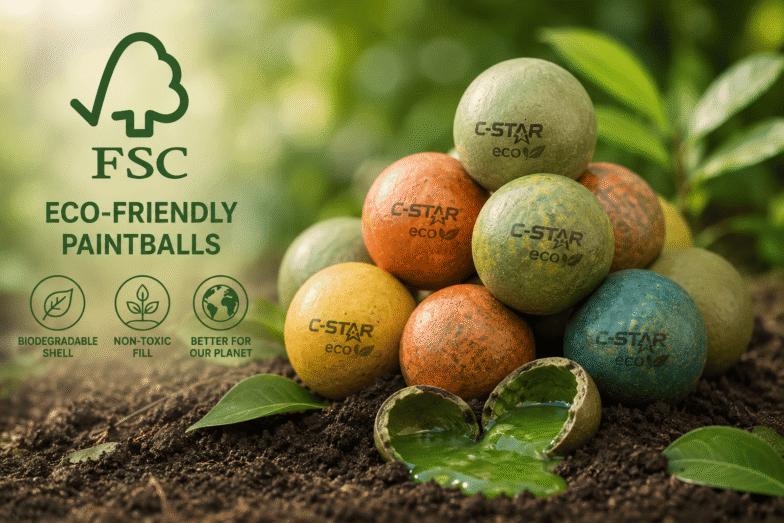
Biodegradable paintballs are formulated to close that gap — breaking down faster and more completely, with no synthetic residues. The difference is not binary. It sits on a spectrum, and understanding where your paint falls on that spectrum is what matters for your field, your budget, and your environmental footprint.
01 What biodegradable actually means for a paintball
There is no single industry standard for what qualifies as biodegradable in paintballs. The term covers a range of approaches:
- Shell composition. Standard gelatin shells can be modified with plasticizers and stabilizers that slow degradation. Biodegradable formulations minimize or eliminate these additives, using only gelatin and natural crosslinking agents that microorganisms readily consume.
- Fill formula. Standard fill contains PEG (polyethylene glycol), glycols, and coloring agents. Biodegradable fills replace PEG with plant-based glycol alternatives and use natural or easily degradable pigments.
- Dye chemistry. Bright synthetic dyes used in standard paint can persist in soil and water. Biodegradable paintballs use food-grade, non-persistent colorants that break down alongside the fill.
A properly formulated biodegradable paintball should show visible breakdown within 4-8 weeks in damp soil conditions and be substantially degraded within 3-6 months. Standard paintballs under the same conditions can take 12 months or more, with some synthetic components persisting longer.
02 How they compare: biodegradable vs standard paintballs
03 The environmental argument for switching
The strongest argument for biodegradable paintballs is not about individual shells. It is about cumulative impact. A busy recreational field can see tens of thousands of paintballs fired in a single weekend. Over a season, that means hundreds of thousands of fill residues deposited on the same patch of earth.
Standard fill contains PEG and associated glycol compounds. While these are not classified as hazardous, they are synthetic compounds that do not exist in natural soil ecosystems. Over years of accumulation, they can alter soil chemistry and water drainage. Fields in environmentally sensitive areas or near water tables face the most pressure to address this.
04 Do biodegradable paintballs play differently?
This is the question field owners hear most from players. The short answer: current-generation biodegradable paintballs from reputable manufacturers perform identically to standard paintballs in diameter tolerance, shell thickness, fill weight, velocity consistency, and break pattern.
Early biodegradable paintballs had a reputation for being too brittle (breaking in the breech) or too tough (bouncing off targets). These issues came from manufacturers trying to reformulate the shell without fully understanding the gelatin chemistry. Modern formulations have solved this through better crosslinking control and rigorous batch testing.
05 Storage and shelf life: do they degrade faster?
This is the most common misconception about biodegradable paintballs. Many buyers assume that if a paintball is designed to break down in the environment, it will also break down on the shelf. This is not how the technology works.
Biodegradation requires specific conditions: moisture, microorganisms, oxygen, and temperature above freezing. In a sealed case stored in a dry environment below 80°F, none of those conditions are present. Biodegradable paintballs stored properly have the same 6-12 month shelf life as standard paintballs.
06 The cost picture for fields and importers
Biodegradable paintballs carry a 15-30% premium per case. For a field that goes through 1,000 cases per season, this translates to a meaningful line-item increase. The question is whether the premium is offset by other factors:
- Regulatory compliance: If your field operates in a jurisdiction moving toward biodegradable requirements, switching early avoids compliance costs later.
- Marketing value: Fields that market themselves as eco-friendly can attract environmentally conscious groups, including corporate bookings that specifically seek sustainable venues.
- Field maintenance savings: Faster-degrading paint means less visible residue buildup over time, potentially reducing the frequency of deep-cleaning or soil management.
07 Are regulations pushing the switch?
No nationwide mandates for biodegradable paintballs exist in the US, UK, or EU. However, the regulatory environment is evolving:
- Local environmental permits: Some paintball fields in environmentally sensitive areas (near waterways, in protected natural areas) have had biodegradable requirements written into their operating permits.
- EU sustainability trends: The European Green Deal and related chemicals regulations are driving scrutiny of synthetic compounds used in consumer products, including PEG-based fills.
- Event standards: Some tournament organizers are beginning to specify biodegradable paint as a condition for venue approval, particularly for events in public parks or multi-use recreational areas.
The trend is clear: environmental scrutiny of paintball operations is increasing. Fields that adopt biodegradable paint proactively position themselves ahead of regulatory curves rather than reacting to mandates.
? Frequently Asked Questions
Can I switch half my inventory to biodegradable and keep standard for the rest?
Yes. Many fields run biodegradable as their premium or eco-branded option alongside standard paint for rental packages. This lets you test demand and performance without a full-inventory commitment.
Do biodegradable paintballs have a shorter shelf life?
No. Under proper storage (cool, dry, sealed), they last the same 6-12 months as standard paintballs. The biodegradation process requires specific environmental conditions that are not present in storage.
Are there different grades of biodegradable paintballs?
Yes. The same quality tiers exist: field grade, premium, and tournament grade. The biodegradable attribute is independent of the quality grade. You can choose biodegradable tournament-grade paint or biodegradable field-grade paint depending on your needs.
Is the fill in biodegradable paintballs safe for pets or wildlife?
Biodegradable fill uses plant-based glycols and natural colorants that are significantly less persistent than standard PEG fill. While no paintball fill is intended for consumption, the environmental toxicity profile of biodegradable fill is substantially better.
+ The short version
Biodegradable paintballs have matured from a niche experiment into a viable option for any field or importer. The performance gap with standard paint is closed, the cost premium is manageable and narrowing, and the environmental benefits are real — especially for fields that see high volumes of play.
The decision comes down to your specific situation: your local regulatory environment, your environmental footprint goals, your budget, and your customer base. The technology is ready. The question is whether now is the right time for your operation to make the switch.
Interested in testing biodegradable paintballs for your field? Contact CS Paintballs to request a sample case and current pricing.