
Is Paintball Declining? A Data-Driven Look at the Industry
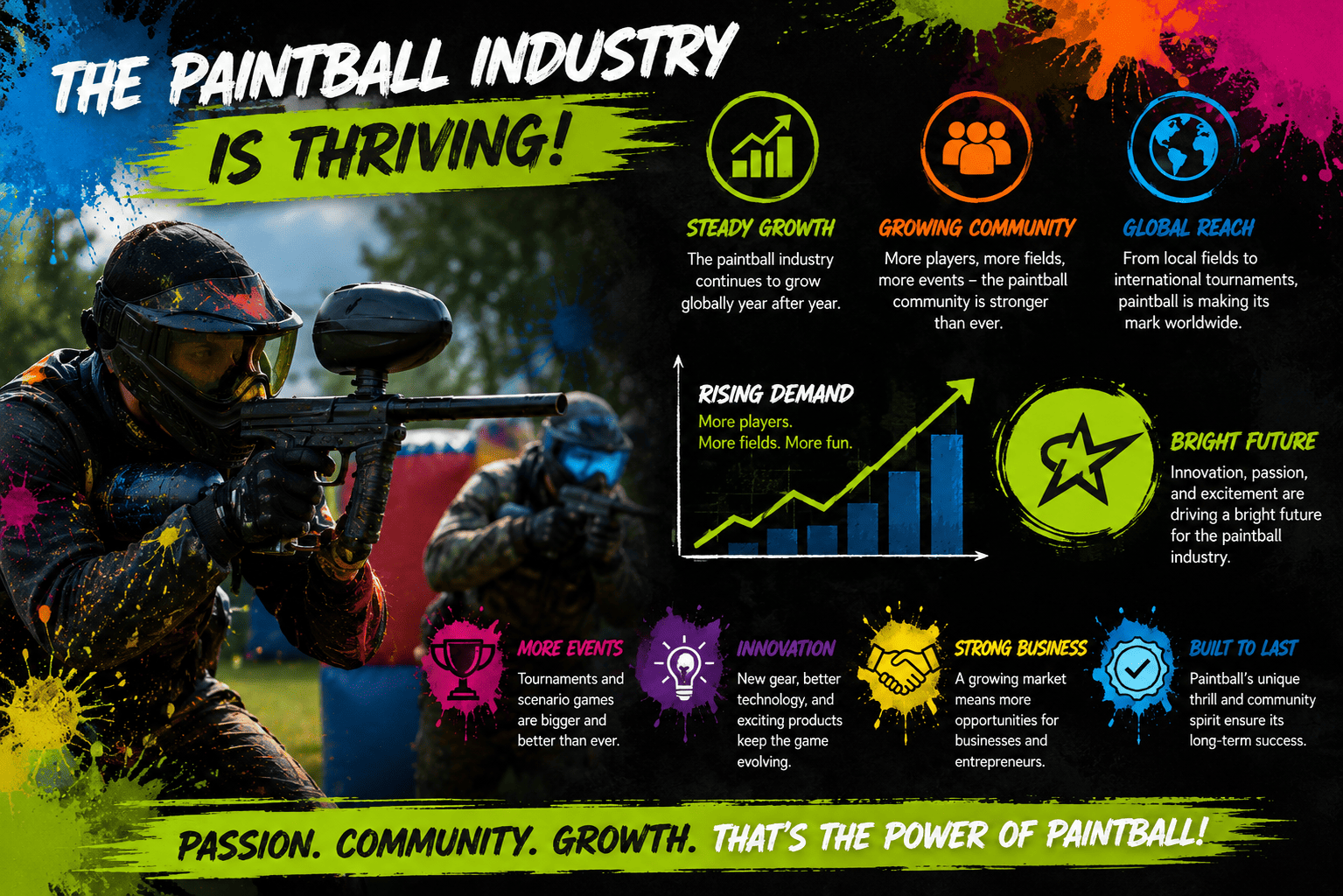
Type “is paintball dying” into Google and you will find thousands of forum threads, YouTube videos, and blog posts stretching back fifteen years. The question has been asked so consistently for so long that the persistence of the question itself might be the best evidence that paintball is, in fact, still here.
But the question deserves a serious answer. Is paintball declining in popularity? The answer is not a simple yes or no. It depends on which metric you look at, which decade you compare to, and which region you are talking about. This article examines the available evidence across five dimensions and draws conclusions based on data rather than anecdote.
Stable The short answer: paintball is not dying, but it has changed
The most important context for any discussion about paintball’s decline is the comparison point. Paintball’s peak mainstream popularity was in the early 2000s, driven by movies, cable TV coverage, and a flood of inexpensive Spyder and Tippmann markers. That was an unsustainable boom, not a baseline. Comparing today’s industry to that peak makes the sport appear to be in decline. Comparing it to the years before and after that peak tells a different story.
Paintball is not the sport it was in 2004, and it never will be again. But that does not mean it is declining. The sport has matured from a fad into a stable recreational activity with a dedicated participant base, professional tournament circuits, and a manufacturing ecosystem that continues to invest in better products.
Growing Dimension 1: Tournament participation
If tournament participation is your metric, paintball is not declining. The NXL (National Xball League) has seen consistent growth in registered teams and events since its founding in 2015. Major events regularly sell out their team caps. The European Millennium Series has maintained stable participation. The Asia Paintball League has grown as the sport expands in new markets.
Several factors support this: professional prize purses have increased, streaming coverage has improved accessibility for spectators, and marker technology has reached a level where the barrier to competitive play is lower than it was a decade ago. The tournament segment is not just surviving — it is expanding.
Mixed Dimension 2: Field counts and openings
This is the dimension where the decline narrative has the most traction. The number of paintball fields in the US has decreased from its peak. Many fields that opened during the 2000s boom closed when the wave receded. However, the rate of closures has slowed significantly since the mid-2010s, and new fields continue to open.
The fields that survived the correction are generally better-run businesses with more sustainable models. The era of opening a paintball field with minimal capital and expecting instant returns is over. The current field ecosystem consists of operations that understand their local market, manage their costs, and invest in customer experience. These fields are stable and, in many cases, profitable.
Growing Dimension 3: Equipment and paint quality
This is a dimension where the industry has clearly improved, not declined. Today’s entry-level markers are more reliable, more consistent, and more affordable (adjusted for inflation) than the entry-level markers of the 2000s. Paintball quality and batch consistency have improved dramatically.
The number of markers sold may be lower than the boom years, but the value delivered per marker is significantly higher. Paintballs are more consistent, shells are more reliable, and fill quality is better across all price tiers. A $200 entry-level marker today performs better than a $500 marker from 2005. This quality improvement lowers the frustration barrier for new players.
Mixed Dimension 4: New player demographics
Paintball’s player demographic has shifted. The casual rental player base remains strong at well-run fields. The weekend recreational player who owns their own equipment has shrunk as a percentage of the total. The competitive tournament player has grown.
The “middle” of paintball — the player who owns their own gear but does not compete seriously — has thinned out. This is the group that is most visible on forums and social media, which amplifies the perception of decline. But the two ends of the spectrum — rental players and tournament players — are stable or growing. The sport is becoming more polarized between casual participants and dedicated competitors, with less in between.
Growing Dimension 5: Regional markets
Paintball’s health varies significantly by region. The North American and Western European markets are mature but stable. The growth story is happening elsewhere.
Asia, particularly China, Southeast Asia, and the Middle East, has seen steady growth in paintball participation and field openings. Eastern Europe has a growing tournament scene. Australia and New Zealand maintain active communities. The global paintball market is not a single story — it is mature in some regions and growing in others. The decline narrative is overwhelmingly a North American and Western European story.
Stable What the data actually tells us
When you look across all five dimensions, a coherent picture emerges:
- Paintball is not dying. The sport has a stable core of participants, a growing tournament scene, and improving product quality.
- Paintball is not returning to its 2000s peak. That era was driven by external factors (media exposure, novelty) that no longer apply. Expecting a return to that level sets unrealistic expectations.
- The industry has matured. The business of paintball — field operations, manufacturing, distribution — is more professional and sustainable than it was 20 years ago. The businesses that survived the correction are stronger.
- The growth is in specific segments: tournament play, Asian markets, product quality, and the rental experience at well-managed fields.
FAQ Frequently Asked Questions
Is paintball dying in 2026?
No. Tournament participation continues to grow, field closures have stabilized, product quality is at an all-time high, and the sport is expanding in Asian and Eastern European markets. The narrative of decline is largely a legacy of comparing the present to the unsustainable peak of the early 2000s.
Is paintball more or less popular than airsoft?
Airsoft has a larger participant base globally, particularly in Asia and Europe, partly because of lower operating costs and the appeal of realistic military simulation. However, paintball has a stronger tournament infrastructure, higher average revenue per player, and more established professional circuits. The two sports coexist and serve different segments of the action sports market.
Are paintball manufacturers struggling?
The manufacturing landscape has consolidated. Some brands from the 2000s no longer exist, and the remaining manufacturers operate with leaner business models. However, the major manufacturers continue to invest in R&D, release new products, and serve a stable customer base. The manufacturing sector is smaller than at its peak but more efficient and profitable on a per-unit basis.
What would need to happen for paintball to grow again?
Sustained growth in paintball requires two things: reducing the barrier to entry for new players (cheaper, more reliable entry-level markers and lower paint costs) and increasing the sport’s visibility through streaming, social media, and grassroots marketing. The tournament scene is growing, but the recreational middle has not returned to its previous size. Bringing casual players back without relying on a media-driven boom is the industry’s biggest opportunity.
Final The short version
Paintball is not declining. It has changed. The sport is smaller than its unsustainable 2000s peak but healthier than it was in the post-crash years. Tournament participation is growing. Product quality is at an all-time high. Fields that survived the correction are running better businesses. The growth markets are in Asia and Eastern Europe.
The “paintball is dying” narrative has been repeated for over a decade. The fact that the question keeps being asked while the sport continues to exist, evolve, and in some ways improve is the best evidence that the answer is more nuanced than the headline suggests.
What is your take on paintball’s trajectory? Contact CS Paintballs with your perspective — we are always interested in hearing from the community.