Paintball Import Document Checklist for Distributors
What Distributors Should Collect Before A Paintball Shipment
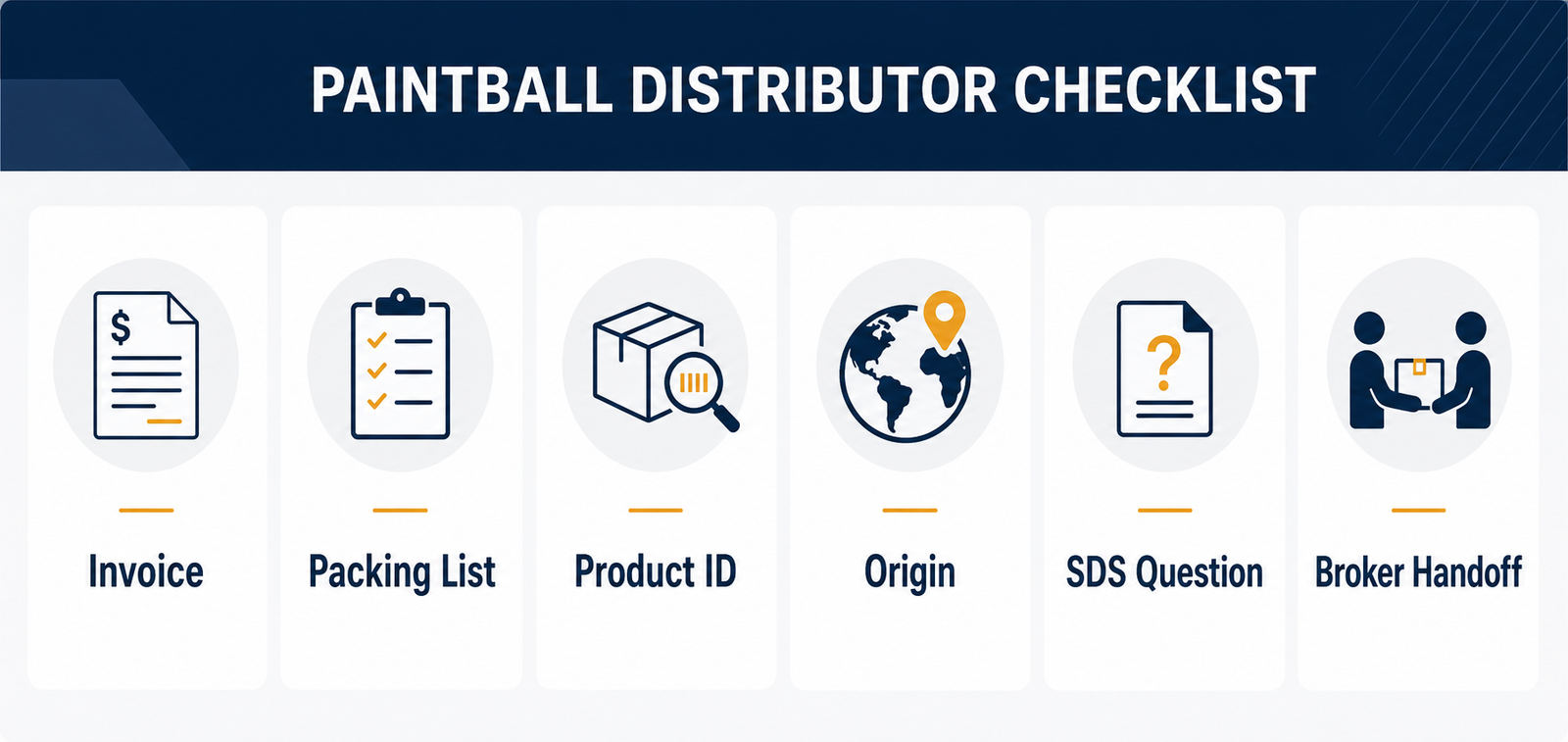
A useful paintball import document checklist should help distributors collect the right information before a shipment reaches the broker, warehouse, or downstream customer-service team. At minimum, buyers should organize the commercial invoice, packing list, product description, supplier details, buyer and consignee information, country of origin, carton and pallet references, private-label artwork approvals where relevant, batch or lot references where used, and SDS or safety-document questions where relevant.
This checklist is not customs advice and it does not promise clearance, tariff treatment, or regulatory status. Its purpose is commercial: reduce avoidable back-and-forth, help the broker review the shipment, support warehouse receiving, and give distributors a cleaner record if questions arise after distribution begins.
For paintball importers, document readiness is part of order risk control. A shipment can look physically ready but still create problems if supplier names, product descriptions, carton counts, batch references, or safety-document files do not match the order.

Why Document Readiness Matters For Distributors
Paintball distributors usually manage more than one audience. The broker needs shipment data. The warehouse needs receiving details. Sales teams may need private-label packaging references. Customer service may need batch or lot information if a customer reports leaking bags, damaged cartons, label confusion, or mixed products. If the document pack is incomplete, each team may ask the supplier a slightly different question after the goods are already moving.
That delay is the commercial problem. Importers should not wait until the container, air shipment, or domestic delivery is already in motion before asking for basic order documents. Buyers should confirm which documents apply to the destination market and which items need broker review before shipment release.
[INTERNAL LINK: Paintball Pre-Shipment Inspection Checklist for Importers]
Core Paintball Import Document Checklist
| Document or data point | What the buyer should check | Who may need it |
|---|---|---|
| Commercial invoice | Seller, buyer, product description, quantity, currency, invoice value, and order reference | Broker, finance, purchasing |
| Packing list | Carton count, case count, pallet count, gross and net weight where provided, SKU references, and carton marks | Broker, warehouse, distributor receiving team |
| Product description | Plain product wording that matches the order and avoids unsupported performance claims | Broker, internal product records, customer service |
| Origin and supplier data | Manufacturer or supplier name, country of origin, shipper details, and seller/buyer consistency | Broker, importer, purchasing |
| Batch or lot references | Batch, lot, production, or carton reference where the supplier uses one | Warehouse, customer service, quality team |
| SDS or safety document | Whether a current document is relevant for the product and destination market | Broker, warehouse, downstream business customers |
| Private-label approvals | Final artwork version, carton marks, bag layout, and customer-approved packaging files | Brand owner, distributor, supplier |
Product Identity: Keep The Description Useful And Low-Risk
The product description should help the broker, warehouse, and distributor understand what is being imported without turning the document pack into a marketing brochure. Buyers should avoid unsupported phrases about quality, breakage, shelf life, certification, or compliance. If a phrase would require product-specific proof, move it out of the public-facing description and ask the supplier for written confirmation internally.
For private-label projects, the distributor should also confirm whether the invoice, packing list, carton labels, and bag artwork refer to the same product name and SKU. Small naming differences can create confusion when a warehouse receives mixed cartons or when a private-label customer checks retail presentation.
[INTERNAL LINK: private-label paintball packaging approval workflow]
U.S. Broker Handoff: Data To Confirm Early
For U.S. vessel cargo, Importer Security Filing rules in 19 CFR Part 149 identify data elements such as seller, buyer, importer number, consignee, manufacturer or supplier, ship-to party, country of origin, commodity HTSUS number, container stuffing location, and consolidator. The regulation also includes timing rules for listed ISF data elements before lading or arrival, depending on the element and shipment type.
For paintball distributors, the practical lesson is not to guess. Buyers should ask their broker which fields are needed, how product descriptions should be written, what classification review is required, and what supplier data should be collected before shipment. The supplier should be able to provide clear shipment details, but the importer and broker should decide how those details are used for entry and filing purposes.
Do not claim a specific HS or HTS code, tariff outcome, customs result, or import status in the article or sales material unless a qualified party has reviewed the product and destination market.
Packing List Consistency: Match Documents To Cartons
A packing list becomes more useful when it connects to the physical shipment. Importers should ask for carton marks, case count, pallet references, and order-specific photos that match the document pack. If the supplier uses batch or lot references, those references should connect to the cartons or shipment summary in a way the distributor can use later.
This does not prove that every carton will arrive without damage. It does help the warehouse compare receiving records with supplier documents and makes it easier to identify which carton group, pallet, or batch a later question may involve.
[INTERNAL LINK: paintball batch consistency for distributors]
SDS And Safety-Document Questions
Some distributors ask for an SDS or similar safety document because warehouses, brokers, carriers, or business customers may request product information. OSHA’s Hazard Communication standard provides U.S. context for labels and safety data sheets where hazardous chemicals are involved. It also describes circumstances where chemical manufacturers or importers provide safety data sheets to distributors or employers.
The buyer should not assume the same document question applies in every market or to every product. Instead, ask the supplier what safety document is current for the product, whether the document matches the specific item being shipped, and whether the broker or warehouse requires it. Do not call a paintball product hazardous, non-hazardous, exempt, or compliant without product-specific documentation.
For distributor records, keep the SDS or safety-document question separate from marketing copy. It belongs in the import and warehouse handoff file, not in unsupported product claims.
[INTERNAL LINK: paintball SDS checklist for importers]
EU-Facing Distributors: Traceability And Product Information
EU-facing distributors should also think about product identity, traceability, and business obligations. The European Commission product-safety page points businesses toward EU product-safety law, Safety Gate, and business obligations related to selling safe products. Regulation (EU) 2023/988 is an in-force general product safety regulation with a current consolidated version available through EUR-Lex.
This article does not determine whether a paintball product satisfies EU rules. It does mean that private-label brands and distributors should discuss product identity, economic-operator information, warnings or instructions where relevant, batch or lot references, and the document files that should be available before distribution.
Supplier Questions To Ask Before Shipment
- Which commercial invoice and packing list versions are final?
- Does the product description match the purchase order and private-label artwork?
- Which batch, lot, carton, or pallet references are used for this shipment?
- Can the supplier provide carton photos that match the packing list?
- Which safety document is current for the product, where relevant?
- Has the broker reviewed the product description and required shipment data?
- Which files should the warehouse receive before the goods arrive?
- Who on the buyer side approves document readiness before shipment release?
FAQs
Is a paintball import document checklist the same as customs advice?
No. A checklist helps buyers organize supplier and shipment information. Customs classification, entry strategy, duty questions, and market-specific legal review should be handled by the importer, broker, or qualified professional.
Should every paintball shipment include an SDS?
Not automatically. Importers should ask what safety document is relevant for the product, destination market, broker, warehouse, and downstream business customer. The answer should be product-specific.
What is the most common document risk for distributors?
A practical risk is mismatch: invoice wording, packing list quantities, carton labels, private-label artwork, and batch references do not line up. That mismatch can create receiving, broker, and customer-service questions.
Can a supplier document pack prove import compliance?
No. Supplier documents can support review and recordkeeping, but they do not prove customs, tariff, safety, or market-compliance outcomes unless the specific product and destination market have been reviewed.
Practical Next Step
Contact C-STAR Paintballs to discuss your destination market, expected order volume, packaging format, and sample requirements.
Sources
- 19 CFR Part 149 – Importer Security Filing, eCFR, accessed 2026-07-08.
- 1910.1200 – Hazard Communication, OSHA, accessed 2026-07-08.
- Product safety, European Commission, accessed 2026-07-08.
- Regulation (EU) 2023/988 on general product safety, EUR-Lex, accessed 2026-07-08.