
Paintball quality control | C-STAR
How to Check Whether Paintballs Are Consistently Round
A practical guide for field owners, importers, distributors, and experienced players who need to distinguish a visible outlier from a repeatable batch-quality issue.
Start with a clean, level-table roll test and a visual rotation check to find obvious outliers. For a purchasing or supplier decision, use a defined sample, measure each ball in multiple directions with a caliper or optical system, calculate the maximum diameter difference, and compare the results with an agreed specification. A curved rolling path is a useful warning sign, not proof by itself: the table, shell seam, surface friction, and paint residue can also affect the result.
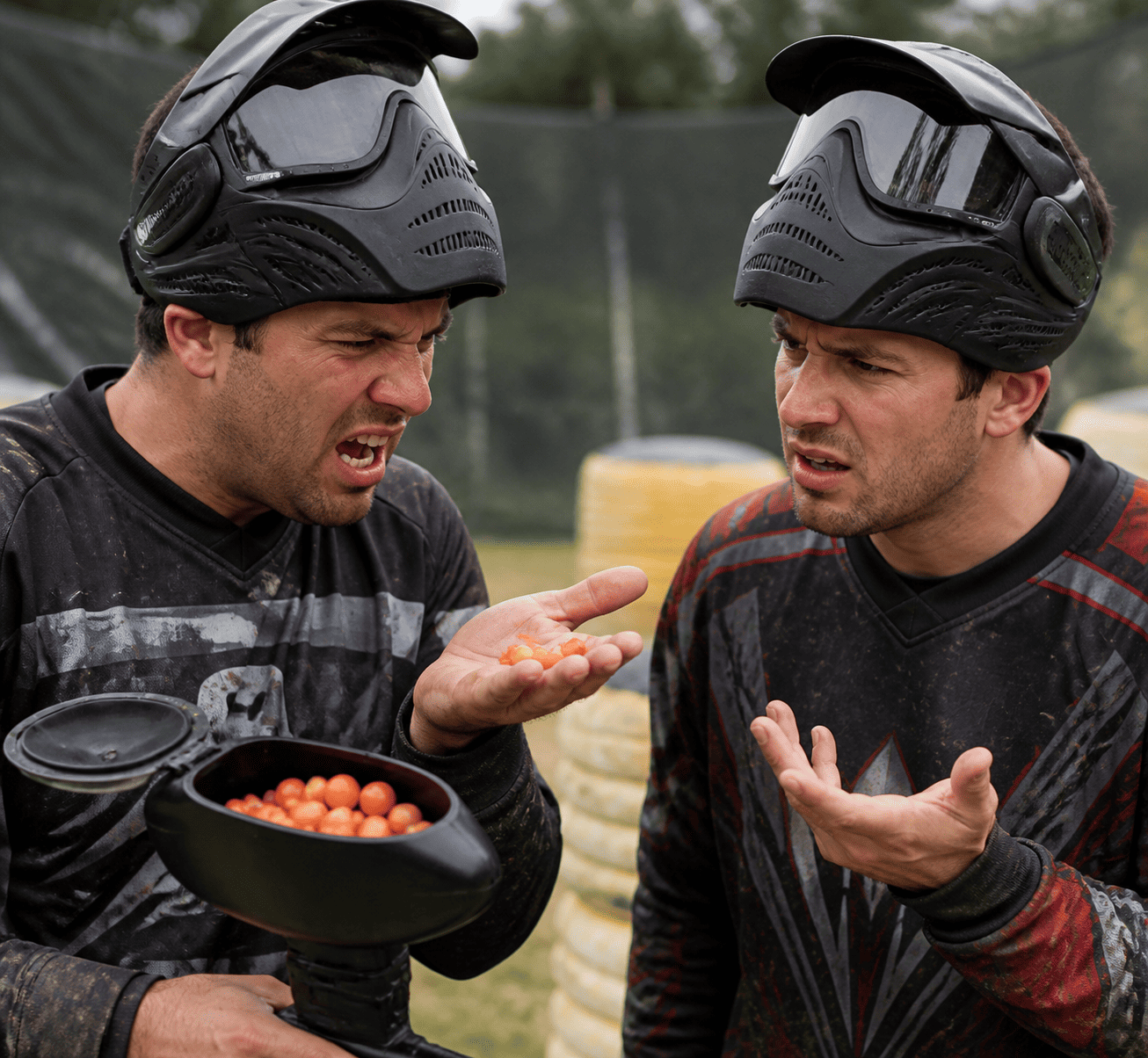
What “round” means in a paintball quality check
In production conversations, “round” can mean several different things:
- Overall diameter: the distance across the ball at one point.
- Diameter variation: the difference between the largest and smallest readings on the same ball.
- Sphericity or form: how closely the entire surface approaches a sphere.
- Concentricity: whether the shell, fill, and outer shape are centered relative to one another.
- Surface condition: dents, flat spots, wrinkles, seam damage, or contamination.
One diameter reading cannot prove that a paintball is spherical. A ball can be within a nominal diameter range while still being slightly oval. A useful inspection program records both numerical variation and visible defects.
No-tool methods for a quick field screening
These methods are inexpensive and practical for a field, shop, or receiving area. They are screening methods only. Do not use them as a substitute for a documented acceptance specification when buying a commercial lot.
1. Roll the paintball across a level table
This is the simplest way to look for a gross shape problem.
- Use a clean, hard, level surface. Remove grit, oil, and paint residue.
- Mark a straight lane with two pieces of tape or use a table edge as a visual reference. The lane should be long enough for the ball to travel at least 20-30 cm.
- Place the paintball at the same starting point and give it a gentle, repeatable push. Do not throw or spin it deliberately.
- Watch the path from above. A persistent, repeatable curve, wobble, or sudden change in direction is a reason to set the ball aside.
- Repeat the test three times. Turn the same ball to a different starting orientation, and repeat with several balls from the same case.
A ball that consistently rolls in an arc may have an oval area, a flat spot, uneven shell geometry, or a heavy seam. A sloping table, damaged finish, sticky shell, or wet patch can create the same symptom. Test a known-good comparison ball on the same lane before blaming the batch.
2. Rotate the ball and look for wobble
Place the paintball on a clean flat surface and gently rotate it with one finger. Observe the top highlight, seam, or a small surface mark as the ball turns. An obvious side-to-side wobble or changing contact point suggests that the ball is not presenting a stable spherical profile.
Repeat the check with the same lighting and a contrasting background. This remains subjective: shell gloss, seam texture, and lighting can make a round ball appear to wobble.
3. Use a light-and-shadow silhouette check
Hold the ball in front of a white background with a steady light behind or beside you. Slowly rotate it and watch the outline. Look for a persistent bulge, flat patch, dent, or lopsided contour. Rotate every candidate rather than judging one fixed view.
The silhouette check is good for finding visible outliers and shipping damage. It cannot detect small form errors or internal fill imbalance, and it should not be described as an optical measurement.
4. Compare rolling behavior side by side
If a field has a retained sample from a previously accepted lot, roll one ball from each lot down adjacent lanes or across the same marked lane in alternating runs. Keep the push, surface, and temperature as similar as possible. A difference that appears repeatedly across multiple balls is more informative than one unusual roll.
This comparative method helps communicate a supplier issue clearly, but it is not a pass/fail standard unless the comparison lot has documented measurements.
Repeatable measurement methods when a batch matters
When the result affects a purchase, a customer complaint, or a supplier corrective action, use a method that another person can repeat.
Caliper screening
A clean digital caliper can provide a useful diameter-variation proxy. Measure each ball in at least three different orientations, approximately 60 degrees apart, without squeezing the shell. Record the largest and smallest readings.
Summarize the lot with the mean, median, range, and percentage of balls above the agreed limit. The limit must be defined with the supplier and tied to the product specification; do not invent a universal tolerance from a single informal test.
Calipers have limitations. Contact pressure can dent a soft shell, the jaws may bridge a seam, and a low-cost tool may not resolve small differences. Use the same instrument, operator technique, and temperature for all comparisons.
Optical or vision measurement
For higher-volume quality control, a camera system can capture a silhouette while the ball is rotated or viewed from multiple angles. Optical measurement reduces contact pressure and can preserve images of outliers. It requires calibration, controlled lighting, a defined image-processing method, and operator training.
The report should identify the instrument, calibration status, lighting, sample temperature, number of views, and calculation method. “Vision inspected” is not enough information for a defensible supplier claim.
How many paintballs should be tested?
There is no single sample size that fits every field or contract. A practical incoming-lot screen can combine:
- a random sample from the top, middle, and bottom of several cases;
- visual and roll screening of every sampled ball;
- caliper or optical measurement of the selected subset;
- a separate functional firing test when safety and local rules allow it.
For a small field purchase, 30-60 balls may reveal obvious outliers. For a large import or contractual release decision, use a written acceptance-sampling plan agreed with the supplier. Record the lot code, case location, storage history, test date, operator, and rejected-ball photos. A larger sample improves confidence, but it does not repair a biased sample taken from only one carton.
Control the conditions before blaming shape
Paintball shells and fills can respond to storage and transport conditions. Before testing, record:
- storage temperature and approximate humidity;
- time since delivery and any visible condensation;
- case compression, damaged bags, or loose lids;
- whether the balls were exposed to freezing, excessive heat, or direct sun;
- barrel, marker, and paint condition for any firing test.
Keep the sample at a stable room condition long enough for the comparison to be meaningful. Do not wash, chill, heat, or deliberately dry one lot unless that is the test being studied. Storage problems can create dents, swelling, brittle shells, or surface tack that changes rolling and firing behavior without a manufacturing roundness defect.
Does roundness always predict accuracy?
No. Roundness is one contributor to consistency, not a complete accuracy model. Flight can also be affected by bore fit, shell strength, fill distribution, dimples, seam condition, velocity, barrel cleanliness, wind, temperature, and the marker’s operating condition.
Confirm the lot
Record the lot code, storage history, and delivery conditions.
Screen the shape
Use visual checks and the level-table roll test to find outliers.
Measure variation
Check multiple orientations with a repeatable method.
Compare performance
Hold marker, barrel, velocity, and weather conditions constant.
This sequence prevents a supplier complaint from relying on a single dramatic but non-repeatable test.
Receiving checklist for field owners
- Record supplier, product grade, lot code, case count, and delivery date.
- Photograph damaged cartons or bags before rearranging them.
- Record storage temperature and unusual heat, cold, or moisture exposure.
- Randomly select balls from multiple cases and case positions.
- Perform the level-table roll test and visual rotation check.
- Measure a defined subset in three orientations if a caliper is available.
- Record outliers instead of discarding them before photographing and labeling them.
- Run a controlled comparison firing test only when safe and permitted.
- Release, quarantine, or escalate the lot using a pre-agreed rule.
What to request from a paintball supplier
Ask for a product specification that defines nominal diameter, storage conditions, lot identification, and the inspection method used for shape and defects. If a supplier states a roundness tolerance, ask how it is measured, what sample size is used, and whether the tolerance applies to every ball or to a statistical sample.
For a recurring issue, send the supplier:
- lot and case identifiers;
- delivery and storage history;
- the test method and instrument;
- raw readings, not only an average;
- photographs or short videos of representative outliers;
- comparison results from an accepted lot;
- the operational impact, such as barrel breaks, cleaning time, or player complaints.
This evidence makes it easier to distinguish a manufacturing variation from handling damage or a setup problem.
How the quality issue connects to field operations
- Field owner inspects a paintball batch.
- The batch carries a lot code, storage history, and measurable shape variation.
- Shape variation may affect flight consistency, barrel breaks, cleaning labor, and player complaints.
- A supplier specification defines the sampling plan, measurement method, and acceptance limit.
- Applicable ASTM paintball specifications inform market and safety compliance decisions.
Standards and limitations
ASTM International publishes paintball-related specifications, including ASTM F1979, Standard Specification for Paintballs Used in the Sport of Paintball. Check the current edition and the requirements applicable to your market and use case at ASTM International. A supplier’s internal roundness limit is not automatically an ASTM certification, and a field inspection is not a laboratory certification.
If a result could affect player safety, a contract release, or a legal dispute, use a qualified laboratory or quality professional and preserve the chain of custody. Local event rules, product regulations, and insurance requirements may impose additional controls.
Frequently asked questions
Can I tell if a paintball is round without tools?
You can identify obvious outliers by rolling it on a clean level table, rotating it for wobble, and checking its silhouette. These methods are screening checks, not proof of a numerical batch tolerance.
What does a curved rolling path mean?
A repeatable curve can indicate an oval area, flat spot, uneven seam, or mass imbalance. Rule out a sloped or contaminated table and confirm the result with a comparison ball and repeated runs.
Is a caliper enough to prove paintball roundness?
No. A caliper provides several diameter readings and a useful variation proxy, but it does not map the entire surface. Use multiple orientations and describe the method accurately.
How does poor roundness affect paintball performance?
Shape variation may contribute to inconsistent release, flight, bore fit, or barrel breaks. Storage, marker, barrel, velocity, weather, and lot conditions must also be compared.
Should a field reject a whole case after finding one bad ball?
Not automatically. Label and retain the outlier, expand the random sample, and apply the documented acceptance rule. A repeated pattern across cases is stronger evidence of a lot-level issue.
Recommended related links
- Link to the site’s paintball quality-consistency guide from the phrase “batch consistency.”
- Link to the storage guide from “storage temperature and humidity.”
- Link to the supplier or OEM page from “paintball supplier quality inspection.”
- Link to the contact or complaint process from “request corrective action.”