
What Makes a Good Paintball? 6 Quality Factors Buyers Should Compare
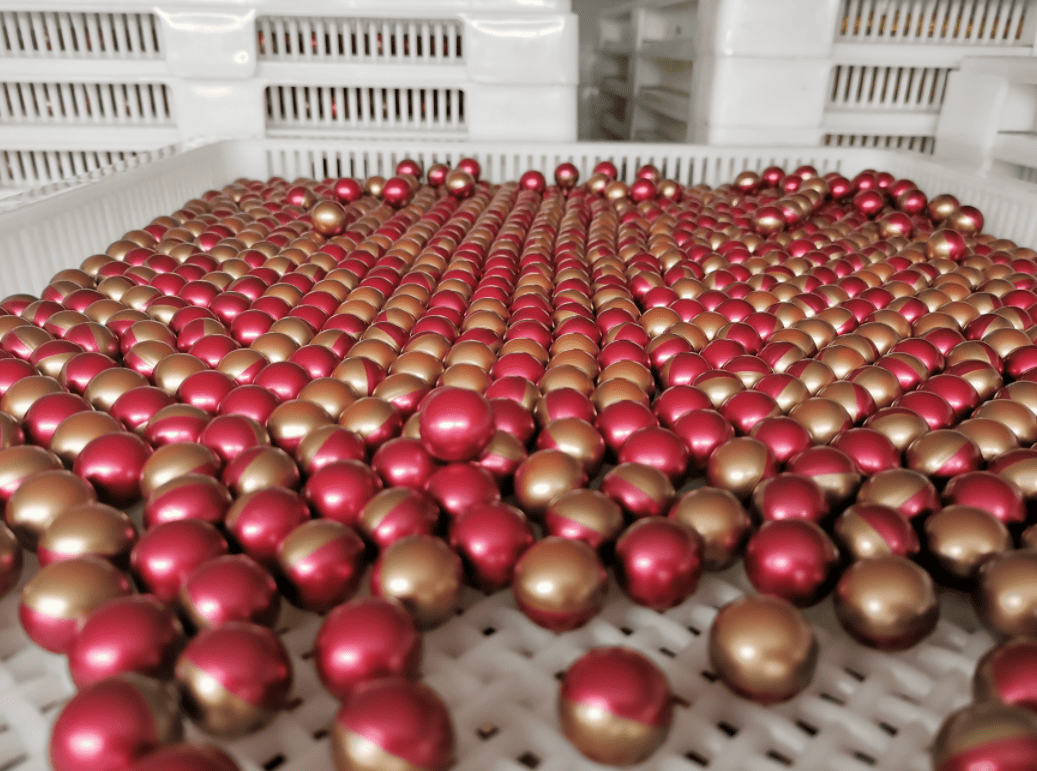
Two cases of paintballs from different manufacturers sit on the shelf. Same price, same color, same grade. One shoots consistently all day. The other produces a mix of tight ropes and random flyers, with occasional barrel breaks. The difference is not luck. It is quality — and quality in paintballs is defined by six measurable factors.
This guide covers the six factors that determine what makes a good paintball, what the acceptable ranges are for each factor, and how to evaluate them when comparing products from different manufacturers.
Factor 1 Diameter consistency
Diameter consistency is the single most important quality factor because it directly affects accuracy, barrel fit, and velocity consistency. A paintball that varies in diameter by 0.005 inches from the spec will either roll past the detent or fit too tightly in the barrel, both causing performance problems.
Factor 2 Shell thickness and uniformity
The shell must be thick enough to survive the breech and barrel but thin enough to break reliably on impact. Inconsistent shell thickness creates weak spots that cause premature breaking or bouncing. A shell that varies by more than 0.003 inches between the equator and the poles will have unpredictable break characteristics.
Factor 3 Fill weight and viscosity consistency
Inconsistent fill weight shifts the center of gravity and changes trajectory. A variance of 0.2g between balls causes measurable trajectory differences at 50+ feet. Fill viscosity should be consistent so that every ball carries the same weight and behaves the same way when it hits a target.
Factor 4 Seam quality
The seam is the line where the two mold halves met during manufacturing. A prominent seam creates asymmetric drag in flight and can shift the center of gravity. A consistent, barely detectable seam is a sign of precision mold alignment and good manufacturing control.
Factor 5 Roundness and shape consistency
A paintball that is not perfectly round will wobble in flight and track inconsistently through the barrel. Out-of-round paintballs are usually caused by improper curing, uneven cooling during manufacturing, or pressure damage during storage and shipping.
Factor 6 Batch consistency and QC data
Individual ball quality is important, but batch consistency is what separates reliable manufacturers from unreliable ones. A manufacturer that provides batch-level QC data for every shipment shows they track and control their production quality. This data is the best evidence of overall manufacturing quality.
Summary Quality factors quick reference
| Factor | Tournament Grade | Field Grade | Field Test |
|---|---|---|---|
| Diameter | +/- 0.002″ | +/- 0.004″ | Digital caliper, 30 balls |
| Shell thickness | 0.030-0.033″ +/- 0.002″ | 0.034-0.038″ +/- 0.003″ | Cut and measure with micrometer |
| Fill weight | Variance under 3% | Variance under 5% | Gram scale, 20 balls |
| Seam height | Under 0.001″ | Under 0.003″ | Fingertip and visual inspection |
| Roundness | Under 0.003″ out-of-round | Under 0.005″ out-of-round | Roll test on flat surface |
| Batch QC | Documented per batch | Documented per shipment | Request data from supplier |
? Frequently Asked Questions
Can a paintball be good in some factors but poor in others?
Yes. A paintball can have excellent diameter consistency but poor seam quality. The key is to evaluate all six factors together. A paintball that scores well on all six factors will perform consistently. A paintball that excels on one factor but fails on another will have unpredictable performance.
What is the fastest way to evaluate a new paintball product?
Run the four no-equipment tests: visual roll test on a flat surface (roundness), fingertip seam test (seam height), squeeze test between fingers (shell firmness), and drop test from waist height onto concrete (break reliability). These four tests take two minutes and catch 80% of quality issues.
How much should I rely on a manufacturers claimed specifications?
Use them as a starting point, but verify with your own testing. A manufacturer claiming +/- 0.002 inch diameter tolerance should be willing to provide batch QC data as evidence. If they cannot or will not provide data, treat their specifications with skepticism. Independent verification is always better than trusting claims.
Do the six quality factors apply to 0.50 caliber paintballs as well?
Yes, the same six factors apply to 0.50 caliber paintballs with adjusted target ranges. The diameter spec is 0.50 inches instead of 0.689 inches, and the shell thickness target is proportionally thinner (0.022-0.026 inches). The same testing methods and quality principles apply.
+ The short version
A good paintball is defined by six measurable factors: diameter consistency, shell thickness uniformity, fill weight and viscosity consistency, seam quality, roundness, and batch QC data. Each factor has specific target ranges for tournament and field grade, and each can be tested with simple equipment.
When comparing paintballs from different manufacturers, prioritize diameter consistency and seam quality, which account for most of the performance difference. Always request batch QC data and verify claimed specifications with your own testing. The manufacturer that provides transparent quality data is most likely to deliver consistent quality across every batch.
Comparing paintball quality across suppliers? Contact CS Paintballs for batch QC data and product samples for every formulation.