
How Do Paintballs Work? From Gelatin Shell to Visible Mark
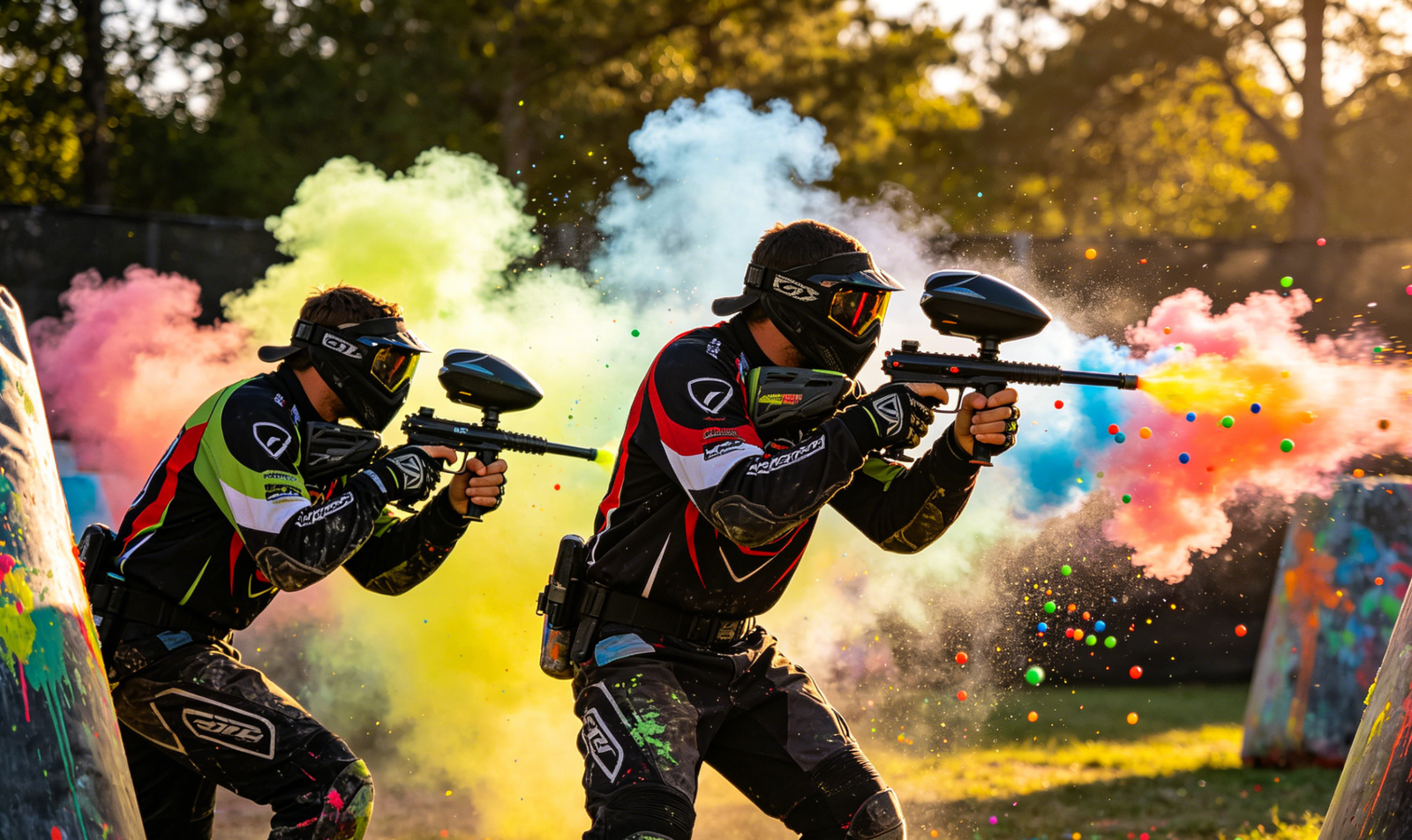
A paintball is deceptively simple. It is a gelatin capsule filled with a colored liquid. When it hits a target, the capsule breaks and leaves a visible mark. That is the entire function of a paintball in one sentence.
But behind that simplicity lies a sophisticated piece of engineering. The gelatin shell must be strong enough to survive acceleration through a marker barrel but brittle enough to break on impact. The fill must be visible enough to mark a target but washable enough to come out of clothing. The manufacturing process must produce millions of identical balls with consistent weight, diameter, and performance.
This guide explains how paintballs work from beginning to end: the raw materials, the manufacturing process, the flight dynamics, and the impact mechanics that turn a gelatin capsule into an unmistakable mark.
Step 1 What is a paintball made of?
A paintball has two components: the shell and the fill. Each is formulated for specific performance requirements.
| Component | Material | Function |
|---|---|---|
| Shell | Food-grade gelatin (porcine or bovine collagen) | Forms the spherical capsule that contains the fill |
| Shell plasticizers | Glycerin, sorbitol | Prevent shell from becoming too brittle; control flexibility |
| Shell opacifier | Titanium dioxide (in white shells) | Provides shell color and opacity |
| Fill carrier | Polyethylene glycol (PEG) + water | Base liquid that carries the coloring agent |
| Fill colorant | Food-grade dyes and pigments | Provides the visible marking color |
| Fill additives | Preservatives, thickeners | Extend shelf life, control viscosity |
The shell typically accounts for 10-15% of the paintball’s total weight. The fill makes up the remaining 85-90%. A standard 0.68 caliber paintball weighs approximately 3.0-3.2 grams.
Step 2 How the shell is made
The gelatin shell is created through a molding process that has remained fundamentally the same for decades, though modern manufacturing has dramatically improved precision and consistency.
The mold consists of two precision-machined halves. When closed, they form a spherical cavity with a small central mandrel that creates the hollow interior. Liquid gelatin at approximately 95-110F is injected into the cavity. The gelatin flows around the mandrel and fills the space between the mold walls.
As the gelatin cools, it transitions from a liquid to a gel state. The mold opens, and the shell is removed. The shell still contains the small opening where the mandrel was positioned — this hole will be used later for filling. The shells are then tumbled in a rotating drum to smooth surface imperfections and dried to stabilize their dimensions.
Step 3 How the fill is made and injected
The fill is prepared separately from the shell and injected after the shells have cured.
The fill formula starts with a base of PEG (polyethylene glycol) and water. The ratio of PEG to water controls the viscosity of the fill. Standard fill uses approximately 40-60% PEG and 40-60% water. Thick fill uses a higher PEG concentration (60-70%) for a more gel-like consistency.
Food-grade dye is added to achieve the desired fill color. The dye is measured precisely to maintain color consistency across production runs. Preservatives are added to prevent microbial growth during storage.
The fill is injected into each shell through the small opening left by the mandrel. A filling machine delivers a precise volume of fill to each shell. After filling, the opening is sealed using heat welding or solvent welding. The seal must be strong enough to survive handling and firing but designed to be the first point of failure on impact.
Step 4 How a paintball flies
When a paintball is fired from a marker, compressed air propels it through the barrel at 280-300 fps (approximately 190-205 mph). The ball spins as it travels due to the interaction between the shell and the barrel rifling.
Paintballs follow a parabolic trajectory influenced by gravity, air resistance, and spin. At 280 fps, a paintball reaches 100 feet in approximately 0.4 seconds. During that time, it drops approximately 8-10 inches from the initial line of flight due to gravity. Experienced players compensate for this drop by aiming higher at longer ranges.
The paintball’s spherical shape is actually a poor aerodynamic design — spheres have high drag coefficients compared to streamlined shapes. A paintball loses velocity rapidly after leaving the barrel. At 100 feet, a ball fired at 280 fps may impact at only 220-240 fps. This velocity loss is why paintballs become less accurate and less reliable at longer ranges.
Step 5 How a paintball breaks and marks
When a paintball hits a target, the kinetic energy of the moving ball transfers to the shell. The shell fractures along its weakest points — typically the seam and the fill hole seal. The fracture creates an opening through which the liquid fill is expelled.
The fill spreads across the target surface, creating the visible mark. The mark’s visibility depends on:
- Fill viscosity. Thicker fill (higher PEG content) creates a more concentrated, opaque mark that spreads less and dries more slowly. Thinner fill spreads more but can be less visible.
- Fill color. Bright colors (yellow, pink, orange) are most visible on dark backgrounds. Dark fill colors are harder to see on targets.
- Impact velocity. Higher velocity creates more forceful fill expulsion and a larger mark. Below approximately 220 fps impact velocity, the shell may break incompletely or not at all (bounce).
- Target surface. Hard surfaces (bunkers, bare skin) create the cleanest breaks. Soft surfaces (loose clothing, padding) absorb impact energy and can reduce mark size.
? Frequently Asked Questions
Is the fill in paintballs actually paint?
Technically, no. Paintball fill is a water-based solution of PEG, water, and food-grade dye. It is more similar to a colored liquid or a water-based marker ink than to house paint or artist paint. The term paintball is historical, dating back to the sport’s origins when early markers were used for marking trees.
Are paintballs biodegradable?
Standard paintballs are partially biodegradable. The gelatin shell is a natural protein that breaks down in the environment. The PEG-based fill is water-soluble and biodegradable, though it takes longer than the shell. Some manufacturers offer fully biodegradable paintballs with plant-based fill formulations.
Why are paintballs round and not some other shape?
Paintballs must be spherical because they are fired through a barrel. A sphere is the only shape that can be loaded, chambered, and fired reliably in a paintball marker. It is also the most consistent shape for manufacturing — a sphere has no orientation and the same dimensions in every direction.
Can you make paintballs at home?
Theoretically yes, but practically no. Producing consistent, round, properly filled paintballs requires precision molds, temperature-controlled gelatin handling, precise fill metering, and quality control equipment. Home-made paintballs are unlikely to be round enough or consistent enough to fire reliably through a marker, and they pose safety risks if the shell is too hard or too brittle.
+ The short version
A paintball is a gelatin capsule filled with a water-soluble PEG and dye solution. The shell is manufactured through a two-part molding process, filled with precision-metered liquid, and sealed. When fired at 280-300 fps, it travels in a parabolic trajectory, losing velocity to drag over distance. On impact above approximately 220 fps, the shell fractures and the fill is expelled, creating an instant visible mark.
The engineering behind this simple device — from gelatin chemistry to mold precision to fill viscosity to impact mechanics — is what separates a paintball that flies straight, breaks reliably, and marks clearly from one that wobbles, bounces, or leaves an invisible mark.
Want to learn more about paintball technology? Contact CS Paintballs for detailed product specifications and manufacturing insights.