
HPA vs CO2 Paintball: Is Nitrogen, Compressed Air or CO2 Better for Your Paintball Marker?
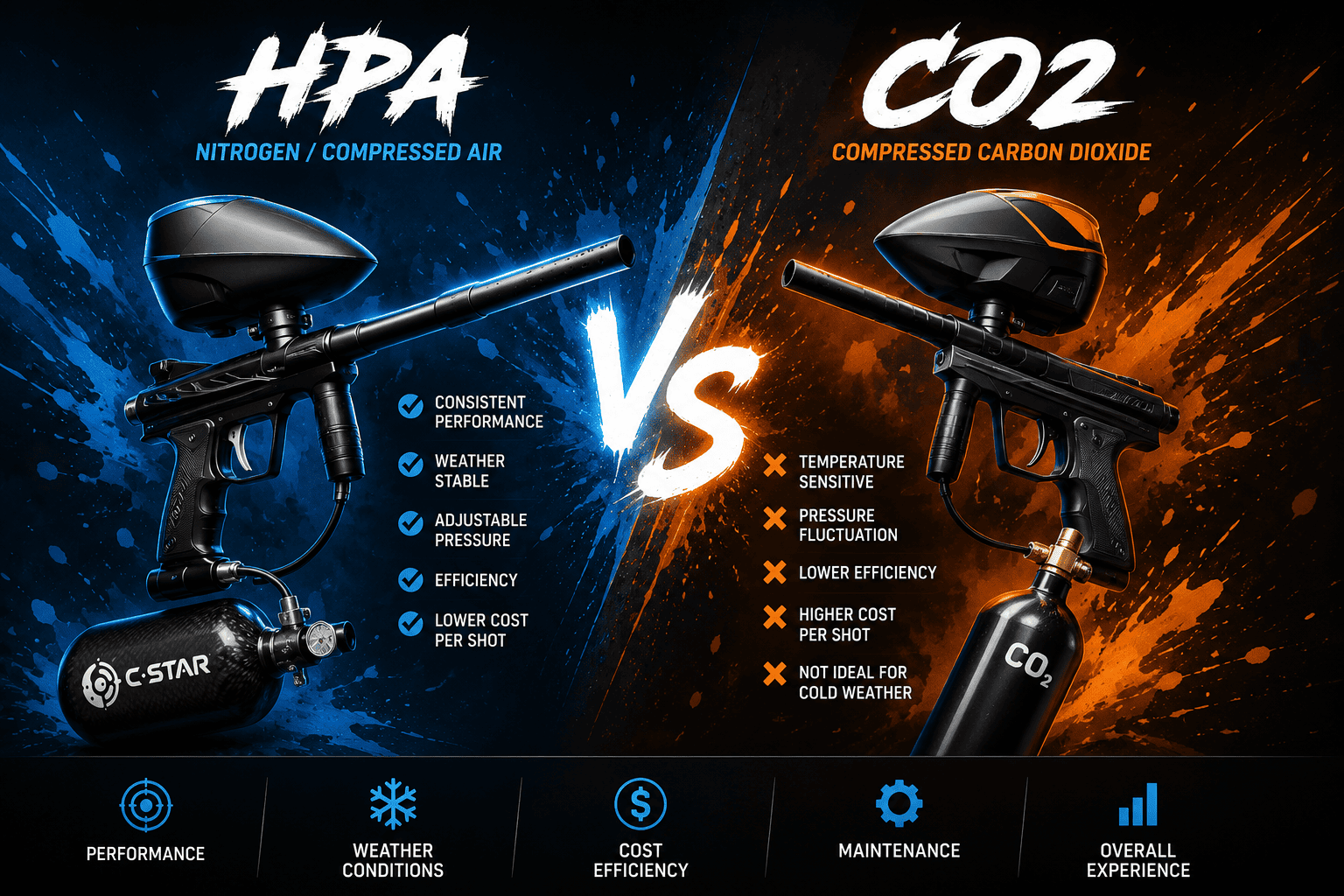
Quick answer: For most modern paintball markers, HPA / compressed air is the best overall choice. In paintball, nitrogen, nitro, N2 and HPA are often used to describe the same high-pressure air system. CO2 is cheaper and still useful for some older mechanical markers, stock-class pistols and 12g cartridge setups, but it is not ideal for modern electronic markers, speedball markers or rental fleets that need consistency.
Are HPA, compressed air and nitrogen the same thing in paintball?
In everyday paintball language, players often use HPA, compressed air, nitro, N2 and nitrogen almost interchangeably. That is why you will see people search for “nitrogen vs CO2 paintball,” “compressed air vs CO2 paintball,” and “HPA vs CO2 paintball” when they are usually asking the same practical question: Which tank should I use on my paintball gun?
Technically, compressed air is not pure nitrogen. It is filtered atmospheric air stored in a high-pressure tank. Atmospheric air is mostly nitrogen and oxygen, so a compressed air paintball tank already contains a large percentage of nitrogen. Pure nitrogen can also power a paintball marker, and older players still call HPA tanks “nitro tanks” because early high-pressure systems often used nitrogen.
For buying decisions, the real comparison is usually this:
- HPA / compressed air / nitrogen system: high-pressure gas stored at 3000 PSI or 4500 PSI, then regulated down before entering the marker.
- CO2 system: carbon dioxide stored mostly as liquid, then converted to gas as it leaves the tank.
Recommended reference reading: ANSgear’s CO2 vs compressed air guide and TippmannParts’ explanation of CO2, HPA, compressed air and nitrogen.
HPA vs CO2 vs nitrogen: paintball air system comparison
| Air source | Common paintball names | How it is stored | Typical tank setup | Best for | Main weakness |
|---|---|---|---|---|---|
| Compressed air / HPA | HPA, compressed air, air tank | Gas only | 3000 PSI or 4500 PSI tank with regulator | Modern markers, electronic markers, speedball, rental fleets, serious players | Higher upfront tank and fill-system cost |
| Nitrogen / N2 | Nitro, nitrogen tank, N2 tank | Gas only | Used like an HPA system when cylinders and fill stations are rated correctly | Fields with bulk nitrogen access, older “nitro” setups, industrial-gas-friendly markets | Less common as a separate consumer refill option than compressed air |
| Carbon dioxide | CO2, CO2 tank, 12g CO2 cartridge | Liquid + vapor | 9 oz, 12 oz, 20 oz tanks or 12g cartridges | Older mechanical markers, stock-class pump, paintball pistols, budget play where CO2 fills are available | Temperature-sensitive, inconsistent during rapid fire, risky for many modern markers |
Bottom line: if your marker manual says “compressed air/nitrogen only” or “HPA only,” do not use CO2. If your marker manual allows CO2, HPA is still usually the better long-term choice unless your local field cannot fill HPA tanks.
The science behind HPA vs CO2 paintball performance
1. CO2 pressure changes dramatically with temperature
CO2 is different from compressed air because it is stored as a liquid-vapor mixture. The pressure inside the tank depends heavily on temperature. This is why a CO2 paintball tank may shoot acceptably on a warm day but become inconsistent in cold weather or during rapid firing.
| Temperature | Approximate CO2 pressure | Paintball effect |
|---|---|---|
| 0°C / 32°F | About 491 psig | Marker may cycle poorly; velocity can drop |
| 20°C / 68°F | About 816 psig | Typical usable CO2 operating range for older mechanical markers |
| 30°C / 86°F | About 1031 psig | Higher pressure; greater risk of hot shots if not controlled |
Source data: R744 / CO2 pressure-temperature chart and Carrier R-744 pressure-temperature chart.
2. HPA and nitrogen behave more predictably as gases
HPA and nitrogen systems store gas, not liquid CO2. A simplified constant-volume gas relationship is:
P2 = P1 × T2 / T1
Temperatures must be in Kelvin. For example, if a gas volume drops from 20°C to 0°C, the temperature ratio is 273K / 293K, or about 0.932. That is roughly a 6.8% pressure change before regulation. In a paintball HPA system, the tank regulator further stabilizes output pressure until the tank pressure falls too low to supply the regulator properly.
This is why HPA paintball tanks usually produce better shot-to-shot consistency, especially in cold weather, speedball, high-rate-of-fire shooting, and electronic paintball markers.
3. Why CO2 can hurt consistency and equipment life
When CO2 expands from liquid to gas, it cools rapidly. During fast shooting, the marker and tank can chill. Liquid CO2 can enter the marker if the setup is not designed to keep liquid out. The result can be velocity spikes, velocity drop-off, frozen O-rings, regulator instability, and solenoid damage in electronic markers.
For a field owner, this is not just a performance issue. It becomes a maintenance issue. More frozen seals, more inconsistent chronograph readings, more customer complaints and more marker downtime all affect operating cost.
Paintball marker compatibility: which guns use HPA, nitrogen or CO2?
The safest rule is simple: follow the marker manual first, not forum advice. The same brand may have older mechanical markers that tolerate CO2 and newer electronic markers that require compressed air or nitrogen only.
| Marker / gun model | Best gas choice | CO2 compatibility | Notes |
|---|---|---|---|
| Tippmann 98 Custom | HPA / compressed air for consistency; CO2 acceptable if manual allows | Generally compatible | A classic mechanical blowback rental marker. Good for fields that still support legacy CO2, but HPA is cleaner and easier to standardize. |
| Tippmann A-5 / Cronus / Stormer-style mechanical markers | HPA recommended; CO2 often supported depending on model and manual | Often compatible | Good woodsball and rental choices. Use HPA when possible for better consistency and simpler refills. |
| Spyder Victor / older Spyder mechanical markers | HPA or CO2 depending on model | Often compatible | Many older entry-level blowback markers were designed during the CO2 era. |
| GoG eNMEy | HPA / nitrogen preferred | Some manuals list CO2 as compatible | Even when CO2 is allowed, HPA is usually more consistent and easier on seals. |
| Empire Mini GS | Compressed air / nitrogen only | No | The manual states that CO2 can damage the marker. Use an HPA tank with a suitable output pressure. |
| Planet Eclipse Etha 3 / Etha 3M | Compressed air / nitrogen only | No | The Etha 3 manual says to use compressed air/nitrogen only and not CO2. |
| DYE DSR+, DYE M3+, DYE CZR+ and modern DYE markers | Compressed air / nitrogen only | Do not use unless the exact manual explicitly allows it | DYE’s current safety page says to use compressed air or nitrogen gas and not CO2. |
Useful manual links: Planet Eclipse Etha 3 manual, Empire Mini GS manual, Tippmann 98 Custom manual, and DYE Paintball manuals and safety notes.
Popular paintball tank models and what gas they use
Most modern paintball tank sales are concentrated around entry-level 48/3000 aluminum HPA tanks and premium 68/4500 carbon fiber HPA tanks. For CO2, 20 oz tanks and 12g cartridges are the common legacy choices.
| Tank type / model | Gas | Typical specification | Best buyer |
|---|---|---|---|
| HK Army 48ci / 3000psi Aluminum HPA Tank | Compressed air / HPA | 48ci, 3000 PSI, standard 800 PSI output | Beginner players, rental fleets, budget-conscious importers |
| Empire / Tippmann 48/3000 Aluminum HPA Tank | Compressed air / HPA | Entry-level aluminum tank, often around 800 PSI output | Fields, schools, beginner packages, wholesale bundles |
| Ninja 68/4500 Carbon Fiber Tank | Compressed air / HPA / nitrogen-compatible system | 68ci, 4500 PSI, popular tournament size | Intermediate to advanced players, speedball, scenario players |
| First Strike Hero 2 68/4500 Carbon Fiber Air Tank | Compressed air / HPA | 4500 PSI, adjustable output regulator range on many versions | Players who want premium weight, ergonomics and adjustable output |
| 20 oz CO2 Tank | CO2 | Filled by weight, common legacy CO2 size | Older mechanical markers where CO2 fills are still available |
| 12g CO2 Cartridge | CO2 | Disposable small cartridge | Stock-class pump, paintball pistols, magfed sidearms |
Product references: HK Army 48/3000 HPA tank, Ninja 68/4500 tank, Empire 48/3000 HPA tank, and First Strike Hero 2 68/4500 tank.
For paintball field owners: which air system is best?
For most paintball field owners, HPA / compressed air is the best long-term operating standard. It works with modern markers, reduces CO2-related freezing problems, allows players to top off tanks between games, and supports both rental fleets and tournament customers.
Recommended field setup
- Primary system: HPA compressor with cascade storage or a professional fill panel.
- Rental marker strategy: standardize around HPA-friendly mechanical markers such as Tippmann-style rentals, then use HPA across the fleet.
- Legacy CO2 support: keep CO2 only if local demand is strong, older customer markers are common, or 12g cartridge play is part of your business.
- Safety workflow: train staff to check hydro dates, inspect tank condition, verify rated pressure, and refuse unsafe cylinders.
Why HPA is better for operations
CO2 may look cheaper at first, but it can create hidden costs: inconsistent velocity, cold-weather complaints, frozen O-rings, fill delays and more marker troubleshooting. HPA has higher infrastructure cost, but it is easier to standardize and better aligned with modern paintball equipment.
For paintball importers and wholesalers: what should you stock?
If you import paintball tanks, markers or field equipment, the safest product strategy is to lead with HPA and treat CO2 as a specialized accessory category.
Recommended product mix
- High-volume beginner SKU: 48/3000 aluminum HPA tank.
- Upgrade SKU: 68/4500 carbon fiber HPA tank.
- Premium SKU: adjustable-output carbon fiber systems from brands such as Ninja or First Strike.
- Legacy SKU: CO2 tanks and 12g cartridges only where local fill infrastructure and legal shipping rules support them.
- Content SKU support: publish compatibility charts, “HPA only” warnings, hydro test guides and refill station FAQs.
Importer insight: many after-sales problems happen because customers buy a CO2 tank for a marker that is actually HPA-only. A simple compatibility table on every product page can reduce returns and protect customer trust.
Safety, hydro testing and equipment lifespan
1. Never use the wrong gas in the wrong marker
If a marker says compressed air/nitrogen only, CO2 should not be used. The risk is not just lower performance. Liquid CO2 can damage solenoids, regulators, seals and internal pneumatic parts.
2. Check hydro dates before filling tanks
Paintball tanks are pressure vessels. Many tanks require periodic hydrostatic requalification. In the United States, cylinder requalification rules are regulated under DOT / eCFR requirements, and PHMSA provides resources for approved cylinder requalifiers. Always follow the markings on the cylinder and your local laws.
Safety resources: 49 CFR 180.209 cylinder requalification requirements and PHMSA cylinder requalifier information.
3. Do not fill HPA tanks with shop compressors
Paintball HPA tanks are commonly rated for 3000 PSI or 4500 PSI. A normal tire compressor or workshop air compressor is not suitable for filling paintball HPA tanks. Use a professional paintball fill station, properly rated compressor, scuba-style cascade system or qualified pro shop.
4. Chronograph every marker
Fields commonly limit paintball marker velocity to 300 feet per second or lower depending on local rules. Always chronograph before play, especially after changing tanks, regulators, paint size, weather conditions or marker settings.
5. Protect carbon fiber tanks
Carbon fiber tanks are lighter and can hold more air, but damage to the wrap can make a tank unsafe or unfillable. Use a tank cover, avoid impacts and never fill a tank that has gouges, burns, cracks or expired certification.
Cost and refill convenience: CO2 vs HPA vs nitrogen
| Factor | HPA / compressed air | Nitrogen / N2 | CO2 |
|---|---|---|---|
| Tank purchase price | Moderate for 48/3000 aluminum; higher for 68/4500 carbon fiber | Similar to HPA if using paintball-rated tanks | Usually lower for basic CO2 bottles |
| Field refill convenience | Very good at modern fields | Good only where nitrogen supply exists | Declining at many modern fields |
| Home refill convenience | Requires proper high-pressure equipment | Requires industrial gas access and rated fill hardware | Requires CO2 fill equipment or exchange source |
| Long-term value | Best for most players because it transfers to future markers | Good where pure nitrogen is available | Best only for legacy or specialty setups |
| Risk of buying the wrong setup | Low if using standard paintball HPA tanks | Medium because terminology can confuse buyers | High if customer owns a modern HPA-only marker |
Final recommendation: is HPA or CO2 better for paintball?
Choose HPA / compressed air for 80–90% of modern paintball use cases. It is the best choice for electronic markers, speedball, field rentals, importers building beginner bundles, and players who want consistent velocity and fewer equipment issues.
Choose nitrogen if your field or region already has a safe, rated nitrogen fill system. In practical paintball use, nitrogen performs similarly to HPA because both are stable gas systems. The main difference is supply chain, not marker performance.
Choose CO2 only when the marker manual allows it and the use case makes sense. CO2 can still be useful for older mechanical markers, casual woodsball, stock-class pump play, 12g paintball pistols and regions where HPA fills are unavailable. Do not use CO2 in HPA-only electronic markers.
Best choice by user type
| User type | Best choice | Why |
|---|---|---|
| Beginner player | 48/3000 HPA tank | Affordable, compatible with most modern markers, easy to upgrade later |
| Speedball player | 68/4500 carbon fiber HPA tank | More shots per fill, lighter weight, better consistency |
| Woodsball player | HPA for most setups; CO2 only for compatible older markers | HPA handles weather and long games better |
| Paintball field owner | HPA compressor and rental fleet standardization | Lower maintenance complexity and better modern equipment support |
| Paintball importer | Stock HPA tanks first, CO2 accessories second | Better compatibility with current marker demand and fewer returns |
FAQ: HPA, nitrogen, compressed air and CO2 for paintball
Is HPA better than CO2 for paintball?
Yes, HPA is better for most modern paintball markers because it is more consistent, less temperature-sensitive and safer for electronic markers. CO2 is mainly useful for older mechanical markers and 12g cartridge systems.
Is compressed air the same as nitrogen in paintball?
In normal paintball conversation, yes, people often use the terms interchangeably. Technically, compressed air is not pure nitrogen; it is filtered atmospheric air. Pure nitrogen can also work when the tank and fill system are rated for it.
Can I use CO2 in an HPA paintball marker?
No, not unless the exact marker manual says CO2 is allowed. If the manual says HPA only or compressed air/nitrogen only, using CO2 may damage the marker.
What is better for cold weather paintball?
HPA or nitrogen is better in cold weather. CO2 pressure drops in cold temperatures, which can cause low velocity, poor cycling and inconsistent shots.
What is better for speedball?
HPA is the clear choice for speedball because electronic markers, high rates of fire and tournament-style consistency all depend on stable regulated air.
What is the best beginner paintball tank?
A 48/3000 aluminum HPA tank is usually the best beginner tank. It is affordable and works with most modern markers. A 68/4500 carbon fiber tank is a better upgrade for players who want lighter weight and more shots per fill.
Does CO2 damage paintball guns?
CO2 can damage paintball guns that are not designed for it. The main risks are liquid CO2 entering the marker, freezing seals, damaging solenoids and causing pressure instability.
Should paintball fields still offer CO2 fills?
Only if there is enough local demand from older mechanical marker users or 12g cartridge players. For most modern field operations, HPA is easier to standardize and better for customer experience.