
OEM Paintball Manufacturing Guide: How to Find the Right Partner
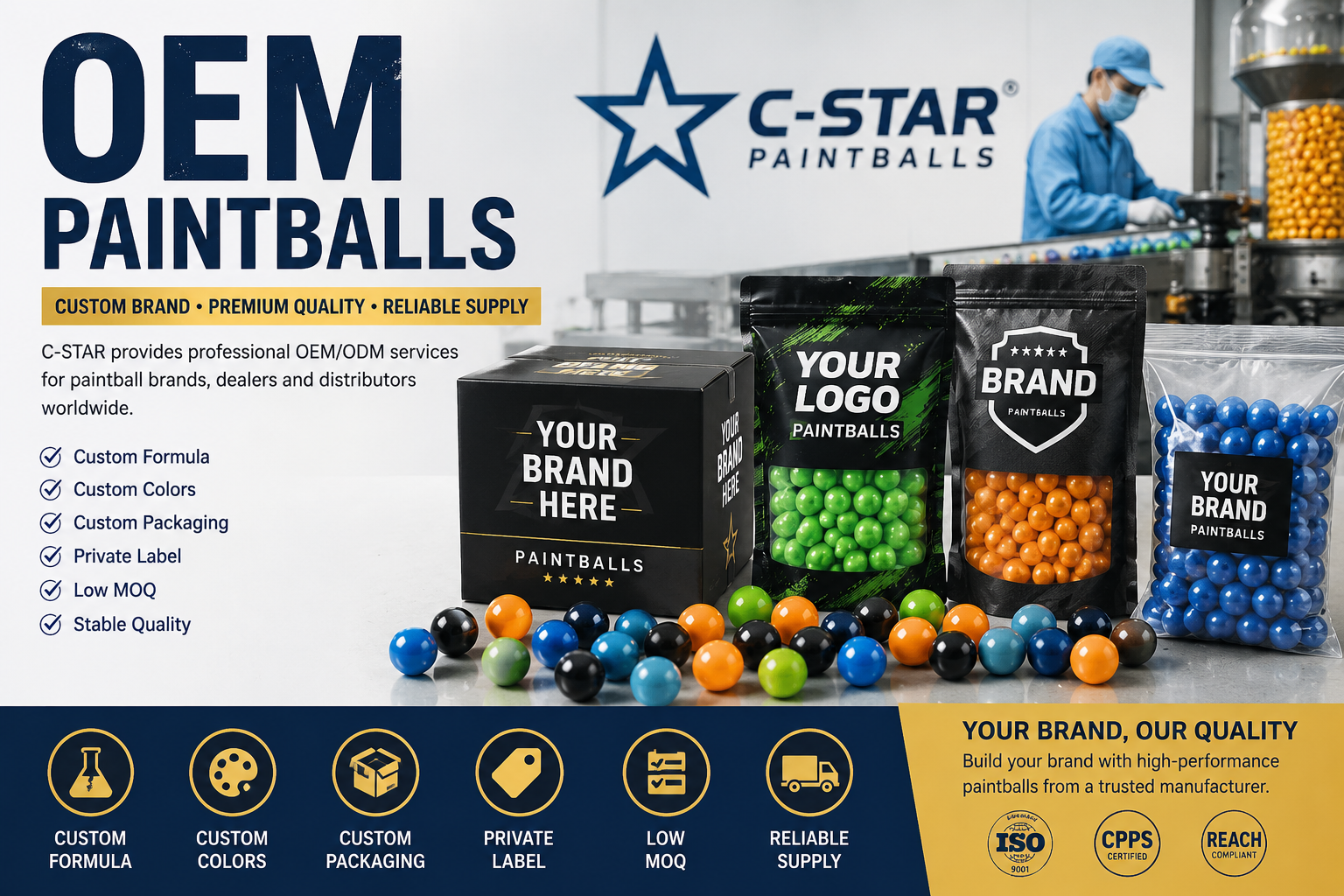
Starting a paintball brand is straightforward. Getting a manufacturer to produce paintballs to your exact specifications is a process that requires patience, due diligence, and a clear understanding of what you need. The difference between a successful OEM partnership and a failed one usually comes down to preparation before the first sample is ever produced.
This guide covers the full journey of paintball OEM manufacturing from defining your requirements to scaling production, with a focus on the business and relationship aspects that determine whether a partnership thrives or fails.
Overview What OEM manufacturing means for paintball brands
OEM manufacturing is the most involved way to bring a paintball product to market. Unlike buying white-label paint (standard product, no branding) or private labeling (your brand on standard product), OEM means you specify the formulation, performance characteristics, and quality standards, and the factory produces to your requirements.
The trade-off is significant: higher MOQs, longer development timelines, and a larger upfront investment. The advantage is that you own the formulation and can build a brand around a product that performs exactly as you designed it, rather than selling a repackaged version of what everyone else sells.
Requirements Defining your OEM requirements
Before contacting any manufacturer, you need a clear specification document. This document becomes the foundation of your OEM agreement and the reference point for every quality check that follows.
- Product type. Paintballs, markers, masks, or accessories. Each product category has different OEM requirements and different manufacturers.
- Target specifications. For paintballs: diameter tolerance, shell thickness, fill type, fill color, shell color, velocity consistency, and shelf life target.
- Quality grade. Tournament grade, field grade, or custom. This determines the acceptable tolerance ranges for every specification.
- Volume estimates. Annual volume, order frequency, and initial order size. Manufacturers need this to assess production capacity and pricing.
- Packaging requirements. Case design, labeling, case count, pallet configuration, and any retail-ready packaging needs.
- Target price range. Your target FOB or CIF price per case/unit helps the manufacturer determine if your project fits their production model.
Vetting Finding and vetting OEM manufacturers
Not every paintball factory is capable of true OEM work. Here is a vetting framework for evaluating potential partners.
Evaluate their standard product quality before discussing custom work. Consistent standard product is a prerequisite for successful OEM development.
Does the factory have an in-house lab with trained formulation technicians? Ask about their equipment and the qualifications of their R&D team. Factories that outsource formulation development add complexity and cost to OEM projects.
Ask for examples of existing OEM clients and contact them if possible. A manufacturer with a portfolio of active OEM relationships has proven processes for formulation development, QC, and communication.
OEM development requires frequent, detailed communication. If a manufacturer takes 3-4 days to respond during the inquiry phase, expect similar delays during production. Response time within 24 hours is the benchmark for a serious partner.
Terms Pricing, MOQ, and payment terms
OEM pricing is higher than standard product pricing because it includes formulation development, dedicated production setup, and enhanced QC. Understanding the cost structure helps you negotiate effectively.
| Cost Component | Typical Range | Notes |
|---|---|---|
| Formulation development fee | $500-3,000 | One-time; may be waived for large orders |
| Sample production (per round) | $200-800 | 2-3 rounds typical for first project |
| Per-case OEM premium | 20-50% over standard | Including enhanced QC and dedicated setup |
| Deposit on first order | 30-50% | Paid before production begins |
| Balance payment | 50-70% | Due before shipment or on bill of lading |
Payment terms vary by manufacturer and relationship. For first-time OEM clients, expect 30-50% deposit with the balance before shipment. As the relationship develops, established partners may negotiate to 30% deposit with 70% on bill of lading.
IP Protecting your intellectual property
IP protection is a legitimate concern in OEM manufacturing, especially when working with overseas partners. Here is a practical approach to protecting your formulation and brand.
- NDA first. Have a non-disclosure agreement in place before sharing your complete specification document. This establishes legal protection from the start.
- Trademark registration. Register your trademark in the manufacturing country. If you are working with a Chinese factory, register your trademark in China. Chinese trademark law operates on a first-to-file basis, and someone else can register your brand name if you do not.
- Split the formulation. For proprietary formulations, consider splitting the spec so that no single person at the factory has the complete recipe. The gelatin formulation can be handled by one team and the fill formula by another.
- Document ownership. Your OEM agreement should state clearly that the formulation, specifications, and any proprietary knowledge developed during the project belong to you, not the manufacturer. This includes the right to take the formulation to a different manufacturer in the future.
Quality Quality agreements and batch acceptance
A quality agreement is a legally binding document that specifies exactly what constitutes an acceptable batch. It protects both you and the manufacturer by removing ambiguity about quality standards.
- QC tests. List every test that will be run on each production batch: diameter distribution, shell thickness measurement, fill weight check, chronograph velocity test, and break pattern evaluation.
- Acceptable tolerances. Define the acceptable range for each test parameter. For tournament-grade paint: 0.689 inches with +/- 0.002 inch tolerance, shell thickness of 0.032 inches with +/- 0.002 inches, fill weight variance under 2%.
- Sampling frequency. Specify how many samples are tested per batch. For a 100-case batch, a standard protocol is 30 balls for diameter, 10 for shell thickness, 20 for fill weight, and 50 for chronograph.
- Out-of-spec protocol. What happens if a batch falls outside the specified tolerances? Common options: reject the batch (manufacturer covers cost), accept at a discounted price, or rework and re-test.
- Pre-shipment samples. Require that samples from the production run are sent and approved before the full shipment is released. This is your last opportunity to catch issues.
Scaling From sample to production: the scale-up process
The transition from approved samples to full production is where many OEM projects encounter problems. Here is how to manage the scale-up.
- Start with a pilot run. Order 50-100 cases before committing to a full container. This validates the formulation at production scale and identifies any issues with the manufacturing process rather than the lab formulation.
- Test the pilot run rigorously. Run the same QC tests on the pilot batch that you plan to run on every production batch. Compare the results to the lab samples. Production-scale batches sometimes drift from lab samples because of differences in mixing time, cooling rates, or curing conditions.
- Document the production spec. After the pilot run is approved, lock the formulation and process parameters. Any future changes must go through a formal change control process.
- Scale in stages. After the pilot, scale to 200-300 cases, then to full container loads. Each scale-up step validates that the manufacturing process holds at higher volumes.
- Maintain safety stock. OEM production runs require lead times of 5-8 weeks after the formulation is finalized. Maintain safety stock to cover the gap between orders, especially during the first year when the relationship is still stabilizing.
? Frequently Asked Questions
Can I OEM paintballs from a manufacturer I have never visited?
Yes, but it is higher risk. A video call factory tour, third-party audit report, and references from existing clients reduce but do not eliminate the risk. Visiting the factory in person before committing to a full OEM project is strongly recommended. The trip cost is small compared to the investment in a failed OEM run.
How long does the OEM development process take from first contact to first shipment?
For a first-time OEM project, expect 12-20 weeks. The breakdown: 2-4 weeks for initial discussions and NDA, 4-8 weeks for formulation development and sample iterations (2-3 rounds), 2-3 weeks for pilot production and testing, and 4-6 weeks for the first full production run and shipping. Reorders are faster (5-8 weeks) since the formulation is already approved.
What is the difference between OEM and ODM in paintball manufacturing?
OEM (Original Equipment Manufacturing) means you provide the specifications and the factory produces to them. ODM (Original Design Manufacturing) means the factory has a design or formulation and you can put your brand on it with minor modifications. Most paintball “OEM” is actually ODM with customizations. True OEM — where you develop a completely new formulation from scratch — is less common and requires significantly larger MOQs and budgets.
What if my OEM manufacturer starts selling my formulation to other buyers?
This is why IP protection is essential. Your OEM agreement should include a non-compete clause that prevents the manufacturer from selling your specific formulation to other buyers for a defined period (typically 2-5 years). Enforcing this across international borders is challenging, which is why choosing a reputable manufacturer with a track record of protecting client IP is more important than any legal agreement.
+ The short version
OEM paintball manufacturing gives you control over the product itself, not just the packaging. The process requires clear specifications, careful partner vetting, proper IP protection, and a structured quality agreement. The investment is significant, but the result is a product that performs exactly as you designed it.
The most important factor in OEM success is the manufacturer relationship. Choose a partner who communicates clearly, asks good questions, has a track record of OEM work, and treats your IP with the same seriousness you do. When both sides are committed to the partnership, OEM manufacturing creates products that neither party could create alone.
Ready to discuss OEM manufacturing for your brand? Contact CS Paintballs to discuss your specifications and development timeline.