
How Many Paintball Cases Fit on a Pallet or in a Shipping Container?
An importer is quoted $12 per case FOB for paintballs. They need 2,000 cases. The freight forwarder asks: 20-foot or 40-foot container? The importer does not know the difference in capacity, so they guess. They order a 40-foot container, pay for space they do not fully use, and increase their per-case shipping cost unnecessarily.
This scenario is common among first-time importers who do not know the standard capacities of shipping containers and pallets. Understanding these numbers is essential for accurate logistics planning and cost optimization. This guide covers how many paintball cases fit on a pallet, in a 20-foot container, and in a 40-foot container, with weight and cost considerations for each option.
Pallets Cases per pallet: the baseline measurement
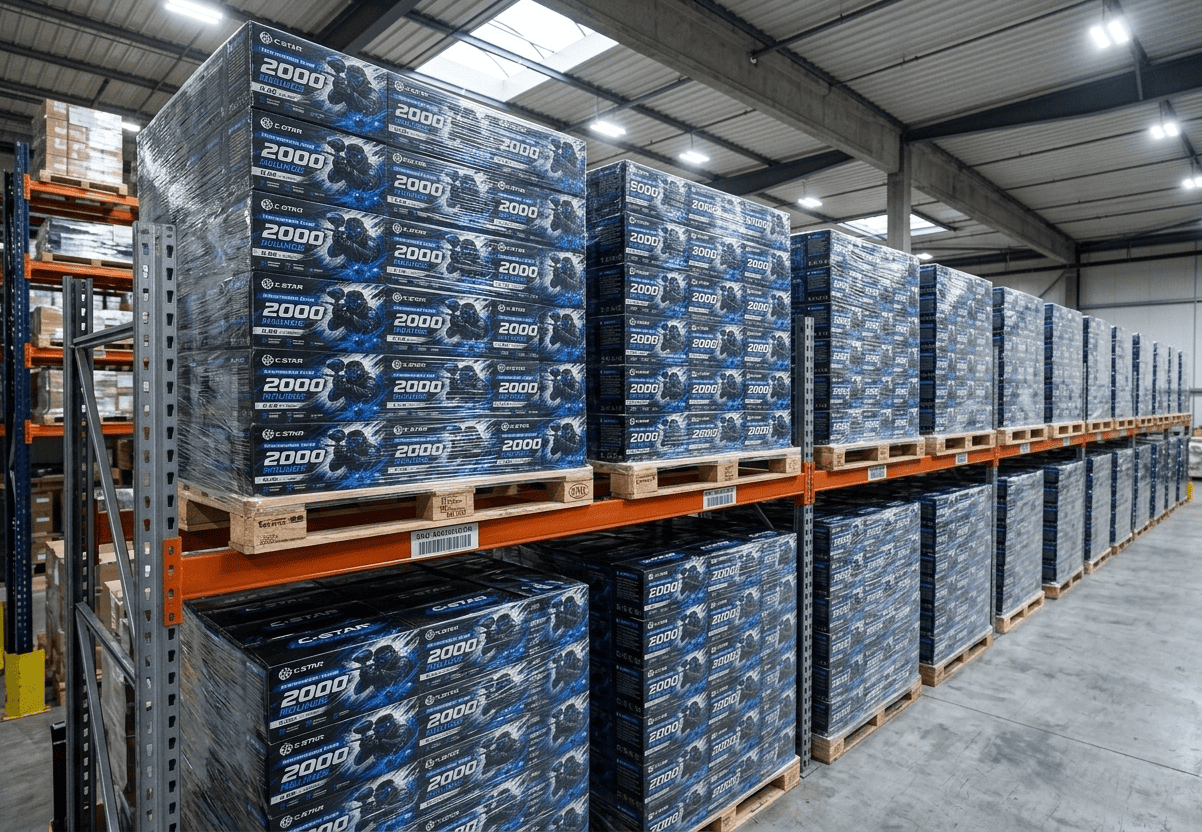
Every container calculation starts with the pallet. A standard pallet of 0.68 caliber paintballs holds 150 to 176 cases, depending on the manufacturer box dimensions and stacking configuration. The stack height is approximately 2 meters (78 inches), which is the standard limit for warehouse racking and freight truck loading.
A typical pallet uses a 1200 x 1000 mm (48 x 40 inch) footprint, which is the standard for ocean freight. The cases are stacked in a column pattern that maximizes stability while staying within the height limit.
| Pallet Specification | Value |
|---|---|
| Pallet footprint (standard) | 1200 x 1000 mm (48 x 40 in) |
| Cases per pallet | 150-176 cases |
| Stack height | ~2 meters (78 in) |
| Rounds per pallet | 300,000-352,000 (at 2,000/case) |
| Pallet weight (loaded) | ~1,000-1,200 kg (2,200-2,600 lbs) |
20ft Cases in a 20-foot container
A standard 20-foot shipping container has internal dimensions of approximately 5.9 x 2.35 x 2.39 meters (232 x 92 x 94 inches). It can hold 10 standard pallets (5,900 mm / 1,000 mm per pallet row x 2 rows).
At 150-176 cases per pallet, a 20-foot container holds:
- Cases: 1,500 to 1,760 cases
- Rounds: 3,000,000 to 3,520,000 (at 2,000 rounds per case)
- Total weight: Approximately 10,000-12,000 kg (22,000-26,000 lbs)
The 20-foot container is the best option for first-time importers or smaller orders. It gives you a manageable inventory volume (1,500-1,700 cases typically covers 1-2 months for a medium-sized field operation) at a lower total investment than a 40-foot container.
40ft Cases in a 40-foot container
A standard 40-foot container measures 12.0 x 2.35 x 2.39 meters (472 x 92 x 94 inches). It holds 20-22 standard pallets in a single row configuration. A 40-foot high cube (HC) container adds approximately 30 cm (12 inches) of height, which can allow an additional row of boxes per pallet, increasing the count to 22-24 pallets.
| Container Type | Pallets | Cases | Total Rounds | Est. Weight |
|---|---|---|---|---|
| 20-ft standard | 10 | 1,500-1,760 | 3.0-3.5M | 10,000-12,000 kg |
| 40-ft standard | 20-22 | 3,000-3,872 | 6.0-7.7M | 20,000-26,000 kg |
| 40-ft high cube | 22-24 | 3,300-4,224 | 6.6-8.4M | 22,000-28,000 kg |
A 40-foot container is cost-effective for established importers who can move 3,000+ cases within a reasonable timeframe (2-4 months for a busy field or distributor). The per-case shipping cost is approximately 30-40% lower than a 20-foot container.
Comparison 20-foot vs 40-foot: cost comparison
The choice between container sizes affects your per-case landed cost significantly. Here is a typical cost comparison for shipping from China to the US West Coast:
| Cost Factor | 20-ft Container | 40-ft Container |
|---|---|---|
| Ocean freight (est.) | $2,000-3,500 | $3,000-6,000 |
| Cases per container | 1,500-1,760 | 3,000-3,872 |
| Freight cost per case | $1.14-2.33 | $0.77-2.00 |
| Total inventory investment | Lower (less capital) | Higher (more capital) |
| Storage requirement | ~1 pallet row | ~2 pallet rows |
The 40-foot container saves approximately 20-40% on per-case freight cost compared to a 20-foot container. However, it requires more capital for the larger inventory purchase and more warehouse space. For most medium-sized importers, the 20-foot container is the right starting point. Move to 40-foot as your volume grows.
Weight Weight considerations and limits
Paintballs are light relative to their volume, so most paintball containers are volume-limited rather than weight-limited. But weight still matters for shipping cost calculation and regulatory compliance.
- Case weight. A standard 2,000-round case of 0.68 caliber paintballs weighs approximately 11-13 lbs (5-6 kg).
- Pallet weight. A loaded pallet of 150-176 cases weighs approximately 2,200-2,600 lbs (1,000-1,200 kg).
- 20-ft container payload. Maximum payload is approximately 28,000 kg (61,700 lbs). A full load of paintballs at 12,000 kg is well within this limit.
- 40-ft container payload. Approximately 26,500 kg (58,400 lbs). A full load at 26,000 kg is close to the limit for 40-ft standard containers but still under.
LCL/FCL LCL vs FCL: which is right for your order?
Not every order fills a full container. For smaller volumes, LCL (Less than Container Load) shipping is an alternative to FCL (Full Container Load).
- LCL (less than container load). Your paintballs share a container with other cargo. You pay per cubic meter of space used. Minimum shipment: approximately 1-2 cubic meters (10-20 cases). Good for orders under 500 cases.
- FCL (full container load). You have exclusive use of the container. You pay a flat rate regardless of how much space you use. Minimum economical shipment: approximately 60-70% of container capacity (1,000+ cases for 20-ft, 2,000+ for 40-ft).
The break-even point between LCL and FCL is typically around 500-700 cases for a 20-foot container. Below this, LCL is cheaper. Above this, FCL is more cost-effective per case. For 40-foot containers, the break-even is around 1,500-2,000 cases.
Best Practice Palletizing and loading best practices
How you palletize and load paintballs affects both shipping cost and product condition upon arrival.
- Pallet configuration. Cases should be stacked in a column stack (boxes aligned vertically) for maximum stability. Interlocking patterns (brick style) can damage the bottom cases.
- Shrink wrapping. Each pallet should be shrink-wrapped to stabilize the stack and protect cases from moisture. Use at least 3-4 layers of stretch wrap.
- Pallet labeling. Each pallet should have labels on two adjacent sides showing: product name, quantity, batch number, and gross weight.
- Container loading. Pallets should be loaded in a single row (for 40-ft) or double row (for 20-ft) with minimal gaps. Use dunnage bags to secure pallets and prevent movement during transit.
- Temperature monitoring. For summer shipments, place a temperature data logger in the center of the cargo to monitor heat exposure during transit.
? Frequently Asked Questions
Can I fit more cases in a container by removing pallets and stacking directly?
Technically yes, but it is not recommended. Palletless loading (floor loading) can increase case count by 10-15% but makes unloading much harder and increases the risk of damage during transit. Pallets allow forklift unloading at the destination, which is faster, safer, and worth the slight reduction in total case count.
How do box dimensions vary between manufacturers?
Case dimensions vary slightly between manufacturers. A standard case is approximately 400 x 300 x 250 mm (15.7 x 11.8 x 9.8 inches). Some manufacturers use slightly different dimensions, which affects how many cases fit per pallet and per container. Always confirm the exact case dimensions with your supplier before calculating container capacity.
Does pallet type affect the case count per container?
Yes. Standard wood pallets are approximately 150 mm (6 inches) tall, which reduces the usable vertical space slightly. Plastic pallets are thinner (approximately 100 mm / 4 inches). If you use plastic pallets, you may gain an additional layer of cases per pallet stack, increasing the total count by 5-10 cases per pallet.
What is the difference between a 40-ft standard and 40-ft high cube container for paintballs?
A high cube container has an additional 30 cm (12 inches) of internal height. This extra height allows an additional layer of cases per pallet stack, increasing total capacity by approximately 10-15%. For paintballs, the high cube is worthwhile if the extra cases cover the additional container cost.
+ The short version
A standard pallet holds 150-176 cases of paintballs. A 20-foot container holds 10 pallets (1,500-1,760 cases). A 40-foot standard container holds 20-22 pallets (3,000-3,872 cases). A 40-foot high cube holds 22-24 pallets (up to 4,224 cases).
Choose your container size based on your order volume: under 500 cases use LCL, 500-1,500 use a 20-foot FCL, and over 1,500 use a 40-foot FCL. The 40-foot container offers a 20-40% lower per-case shipping cost but requires more capital and storage space.
Planning a container shipment of paintballs? Contact CS Paintballs for current container loading configurations and pricing by volume.