
Why Do Paintballs Have Seams? How Seam Quality Affects Performance
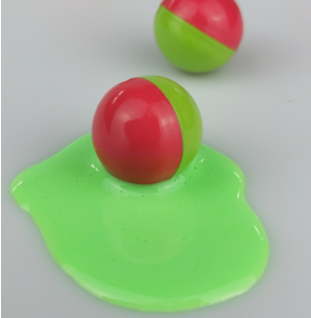
Run your finger across the surface of a paintball and you will feel it: a thin raised line running around the circumference of the ball, like the equator on a globe. That line is the seam, and it is one of the most revealing indicators of paintball manufacturing quality.
Every paintball seam is a byproduct of how paintballs are manufactured. The seam itself is not a defect — it is an inherent feature of the molding process. But the quality of the seam — its height, uniformity, and smoothness — tells you a great deal about the manufacturer’s precision, mold maintenance, and quality control standards.
Why Seams Why paintballs have seams: the manufacturing process
Paintballs are manufactured using a two-part mold process. Liquid gelatin is injected into a mold cavity, the two halves of the mold close together, and the gelatin sets to form a hollow sphere. The line where the two mold halves meet creates the seam.
The process is similar to how plastic injection molded products are made. The mold consists of two precision-machined halves that fit together. When they close, there is a microscopic gap between them. Gelatin seeps into this gap and forms a thin raised line — the seam. After the shell cures and is filled, the seam may be visible as a slightly raised ridge around the ball’s equator.
Mold Tech How seams are created: the molding process
The seam formation happens in three stages during manufacturing:
- Mold closure. The two halves of the mold close around a mandrel that forms the hollow center of the shell. The precision of the closure determines the initial gap size.
- Gelatin injection. Liquid gelatin is injected into the cavity. The gelatin flows around the mandrel and fills the space between the mold walls. If the mold halves are perfectly aligned, minimal gelatin seeps into the closure gap.
- Curing and release. The gelatin cools and sets. The mold opens, releasing the formed shell. A thin line of excess gelatin (the seam) remains where the mold halves met.
The post-molding process may include tumbling or buffing to smooth the seam, but this step is not universal. Higher-grade paintballs typically receive additional finishing to reduce seam visibility.
Metrics Seam quality metrics: what to measure
Seam quality is measured by three parameters:
- Seam height. How much the seam rises above the surrounding shell surface. Tournament-grade target: under 0.001 inches (0.025 mm). Field-grade: under 0.003 inches. Anything above 0.005 inches indicates mold wear or alignment issues.
- Seam width. How wide the raised seam is. A quality seam is a thin line, not a wide ridge. Target: under 0.010 inches wide.
- Seam consistency. Whether the seam is uniform around the entire circumference. An inconsistent seam — thicker in some areas, thinner in others — indicates mold misalignment or uneven mold wear.
| Grade | Seam Height | Seam Width | Visibility |
|---|---|---|---|
| Tournament | Under 0.001″ | Under 0.008″ | Nearly invisible to the naked eye |
| Premium field | Under 0.002″ | Under 0.012″ | Visible on close inspection |
| Standard field | Under 0.004″ | Under 0.016″ | Easily visible, detectable by touch |
| Budget | Over 0.005″ | Over 0.016″ | Prominent, rough to the touch |
Flight How seams affect flight performance
The seam affects a paintball’s flight in two ways: aerodynamics and weight distribution.
Aerodynamic effect. A raised seam creates asymmetric drag as the ball spins in flight. The seam acts like a small fin, creating a low-pressure zone behind it that pulls the ball in that direction. On a perfectly round ball with a minimal seam, this effect is negligible. On a ball with a prominent seam, the effect can cause the ball to curve or wobble noticeably, especially at longer ranges (80+ feet).
Weight distribution. The seam adds a microscopic amount of material to one “band” of the ball. This shifts the center of gravity slightly toward the seam side. When the ball spins, the off-center weight creates a precession effect similar to a wobbling football. The effect is minimal on tournament-grade paint (seam weight is less than 0.1% of total ball weight) but measurable on budget paint with prominent seams.
Breakage How seams affect break reliability
The seam is also a structural weak point. The gelatin at the seam has a slightly different structure than the rest of the shell because it cooled in a thinner gap between the mold halves. This creates a zone where the shell is slightly more prone to fracture.
In well-made paintballs, this is an advantage — the seam provides a natural fracture line that helps the ball break cleanly on impact. In poorly made paintballs, the seam can be either too weak (causing the ball to split open during handling or loading) or too thick (creating a reinforced ridge that resists breaking).
The ideal seam is thin enough to provide a weak point for clean breaking but not so thin that it compromises shell integrity during handling and firing.
Inspect Inspecting seam quality: what to look for
You do not need specialized equipment to evaluate seam quality. Here is a simple field inspection protocol:
- Visual inspection. Hold a paintball under a bright light and rotate it slowly. A quality seam appears as a thin, uniform line. A poor seam is thick, uneven, or has visible gaps.
- Fingertip test. Run your fingernail across the seam. If you can feel a distinct ridge, the seam is too prominent. You should barely detect the seam with your fingertip on quality paint.
- Roll test. Roll the ball across a flat surface. If the seam causes the ball to wobble or change direction, the seam height is affecting roundness.
- Batch comparison. Inspect 10-20 random balls from a case. Consistent seam quality across the sample is a sign of good manufacturing control. High variation suggests mold wear or inconsistent QC.
QC Manufacturing quality control for seams
Consistent seam quality requires rigorous quality control at the manufacturing level. Here is what reputable manufacturers monitor:
- Mold inspection frequency. Molds should be inspected after every production run for wear, alignment, and surface condition. Premium manufacturers inspect molds after every 10,000-20,000 cycles.
- Mold replacement schedule. Molds have a finite lifespan. Even with regular maintenance, mold surfaces wear over time, producing progressively larger seams. A replacement schedule of 50,000-100,000 cycles is standard for quality production.
- In-process seam monitoring. Automated vision inspection systems can measure seam height on every ball during production. This is now standard practice at top-tier paintball factories.
- Post-production tumbling. A light tumbling or buffing step after demolding can reduce seam height. This adds cost but significantly improves seam quality. Tournament-grade paint typically includes this step.
? Frequently Asked Questions
Can you see the seam on all paintballs?
Yes, the seam is visible on all paintballs if you look closely. On tournament-grade paint, the seam is visible as a thin, almost invisible line that is difficult to see without close inspection. On budget paint, the seam is easily visible and often detectable by touch.
Does seam orientation matter when loading paintballs?
In theory, the seam orientation could affect how the ball interacts with the barrel and breech. In practice, the seam orientation is random when paintballs are loaded into a hopper, and the effect is negligible. No player can consistently orient paintballs by seam direction during loading, and the performance difference is too small to matter.
Is a visible seam always a sign of poor quality?
Not necessarily. A visible seam that is uniform and thin is acceptable for field-grade paint. A visible seam that is thick, uneven, or raised is a quality concern. The key is consistency — consistent seams across a batch indicate controlled manufacturing, regardless of whether the seam is barely visible or easily seen.
Do colored shells hide seams better?
Yes. Opaque or colored shells can make seams less visible to the naked eye because the seam does not reflect light differently from the rest of the shell. However, the seam still exists and affects performance. A colored shell with a bad seam is still a bad seam — it is just harder to see. Always inspect seams by touch, not just by sight.
+ The short version
The paintball seam is an inherent result of the two-part mold manufacturing process. The goal is not to eliminate the seam (which is not cost-effective at scale) but to minimize its height and ensure consistency across every ball in a batch.
A quality seam is under 0.001 inches high, uniform around the entire circumference, and barely detectable by touch. It provides a natural fracture point for clean breaking without compromising flight performance. When selecting paintballs — whether tournament-grade or field-grade — seam quality is one of the most reliable indicators of overall manufacturing quality.
Want to evaluate paintball seam quality for yourself? Contact CS Paintballs to request product samples and compare seam consistency across our product lines.