
Do Paintballs Go Bad Over Time?
The honest, manufacturing-backed answer — what actually happens to paintballs as they age, what’s normal, what’s a problem, and how to salvage stock before it becomes a loss.
Yes — paintballs go bad over time. But the more useful answer is: how fast, why, what it looks like, and what you can still do about it. Most of the quality changes that happen to aging paintballs are predictable, gradual, and to a significant degree, manageable. Understanding the timeline — from the factory to the point of no return — is the difference between a well-run inventory and an expensive write-off.
This guide draws on the production expertise of C-Star Technology Co., Ltd., a paintball manufacturer with over 20 years of experience producing PEG-based paintballs for recreational fields, competitive leagues, and international distributors. Their technical team’s direct production knowledge informs the shelf life benchmarks, leakage explanations, and quality assessment protocols described in this article — offering a level of manufacturing transparency rarely found in consumer-facing content.
The perspective here is not retail advice — it is factory-level honesty about what paintballs are, what happens to them over time, and what buyers should realistically expect.
Section 1: What “Going Bad” Actually Means — A Material Science Baseline
Paintballs are not manufactured to last indefinitely — and that is intentional. Their gelatin shell and PEG fill are both biodegradable by design, made from food-grade ingredients that break down in natural environments. The same property that makes paintballs environmentally responsible makes them time-sensitive in storage.
The gelatin shell is a hygroscopic protein polymer — it continuously exchanges moisture with its surrounding environment. Too much ambient humidity and it swells, softens, and loses shape. Too little and it dries, contracts, and becomes brittle. Add to this the physical weight of thousands of balls pressing against each other, the effect of gravity on stationary spheres, temperature-driven expansion and contraction cycles, and the slow osmotic migration of fill material through the shell membrane — and you have a product whose quality is always in motion, never static.
The gelatin shell of a paintball contains approximately 10–18% water by weight in its optimal state. This moisture content governs shell flexibility, impact-break threshold, and dimensional stability. As the ball ages, two competing processes occur simultaneously: the gelatin polymer slowly undergoes cross-linking (making the shell progressively less elastic and more brittle regardless of moisture), and the PEG fill — being water-soluble and hygroscopic — slowly migrates through microscopic imperfections in the shell-fill interface.
This second process — fill migration — is the origin of the leakage phenomenon described later in this guide. It is not a manufacturing failure in the traditional sense; it is a thermodynamic inevitability driven by concentration gradients and the physical properties of softgel gelatin at scale. Understanding this distinction is critical for anyone managing paintball inventory and assessing supplier quality.
Section 2: The Realistic Shelf Life Timeline
Consumer guides typically cite 3–12 months as the paintball shelf life range, and that range is accurate — but incomplete. It describes the window for peak performance. The full picture, from a manufacturer’s perspective with proper storage conditions, is significantly longer:
mo
Peak Performance Window
Shell maintains ideal hardness and elasticity. Fill viscosity and color intensity at maximum. Diameter consistent with bore specifications. Competitive and tournament play — use fresh paint in this window. No storage-related quality changes visible.
mo
Good Performance — Minor Changes Possible
Slight dimensional change possible in variable humidity environments. Minor flat spots may appear on balls in contact with packaging. Performance remains excellent for recreational play and field operations. The industry’s standard “use within 1 year” recommendation applies here. FIFO stock rotation prevents any issues from accumulating.
mo
Extended Storage — Manageable with Good Conditions
In ideal conditions (cool, dry, sealed, dark, rotated), 2 years is achievable. This is C-Star Technology’s direct production experience. Flat spots become more visible in this range, especially in warmer, humid environments. First signs of fill leakage may appear after 12 months in some batches — particularly summer formula paintballs or product stored in temperature-variable conditions. Quality assessment before use is essential.
mo
Beyond 2 Years — Significant Degradation Expected
Shell cross-linking advanced — break threshold increasingly unpredictable. Fill separation likely in many balls. Leakage common. Flat spots and dimples pervasive. Balls beyond 2 years in uncontrolled storage should be tested rigorously before field deployment, and may not be suitable for competitive use. Recreational play may still be possible — test first.
💡 The Key Variable: Storage Conditions, Not Just Time
Time is only one axis of paintball aging. A paintball stored for 18 months in a climate-controlled room at 65°F and 45% RH may outperform a paintball stored for 4 months in a non-air-conditioned warehouse through a summer. The clock runs faster or slower depending entirely on the environment. This is why field operators in tropical climates may see quality degradation at 4–6 months, while importers with controlled warehouse facilities report usable product at 18–24 months. Both can be true simultaneously.
Section 3: What Actually Happens — Six Quality Changes Over Time
Knowing what to look for — and what each symptom means — is what separates a field operator who can salvage a batch from one who either throws out usable product unnecessarily or deploys genuinely compromised paint onto their game day.
Flat Points
Most CommonSmall flattened areas where balls have rested against each other or packaging surfaces under gravity. In cool, dry storage: minor and often unfelt. In warm, humid conditions: more pronounced and visible. Mild flat points generally do not affect field performance — the ball rounds slightly from heat after firing. Rotating bags every 2–3 weeks significantly reduces this. Winter formula paintballs are more susceptible.
Dimples and Surface Depressions
Humidity-DrivenRounded indentations on the shell surface, typically at contact points with adjacent balls. Distinct from flat points — dimples are caused primarily by moisture absorption causing shell swelling at the points of lowest structural support. More severe than flat points and more likely to affect accuracy and barrel fit. Significant dimpling indicates humidity exposure above the recommended 50% RH threshold. Usually caused by humidity, not age alone.
Shell Softening
Heat / HumidityShell becomes noticeably softer and more deformable to finger pressure. Balls may feel slightly sticky. Caused by heat exposure above 86°F or sustained high humidity. Soft shells produce “bounces” — the ball deforms on target contact but does not break, failing to mark the hit. This is the quality failure that most directly damages player experience and generates complaints. Not recoverable — affected batches should be tested carefully before field deployment.
Shell Brittleness
Cold / DesiccationShell becomes abnormally hard and fragile — breaking in the barrel, hopper, or even under handling pressure before reaching a target. Caused by desiccation (moisture loss below 30% RH) or cold temperature exposure. Brittle paintballs cause barrel breaks that contaminate the marker internals and require time-consuming cleaning. Affects entire sessions if not caught before play.
Fill Separation
Age-RelatedThe fill ingredients — PEG, dye, sorbitol — gradually separate over time as the emulsion breaks down. Visible as color variation between balls or clear liquid pooling at the bottom of the bag. Balls with separated fill may produce inconsistent color marks on target — reduced dye concentration means reduced visibility of hits. Fill separation accelerates in temperature-variable storage environments as expansion/contraction cycles drive ingredient migration.
Fill Leakage
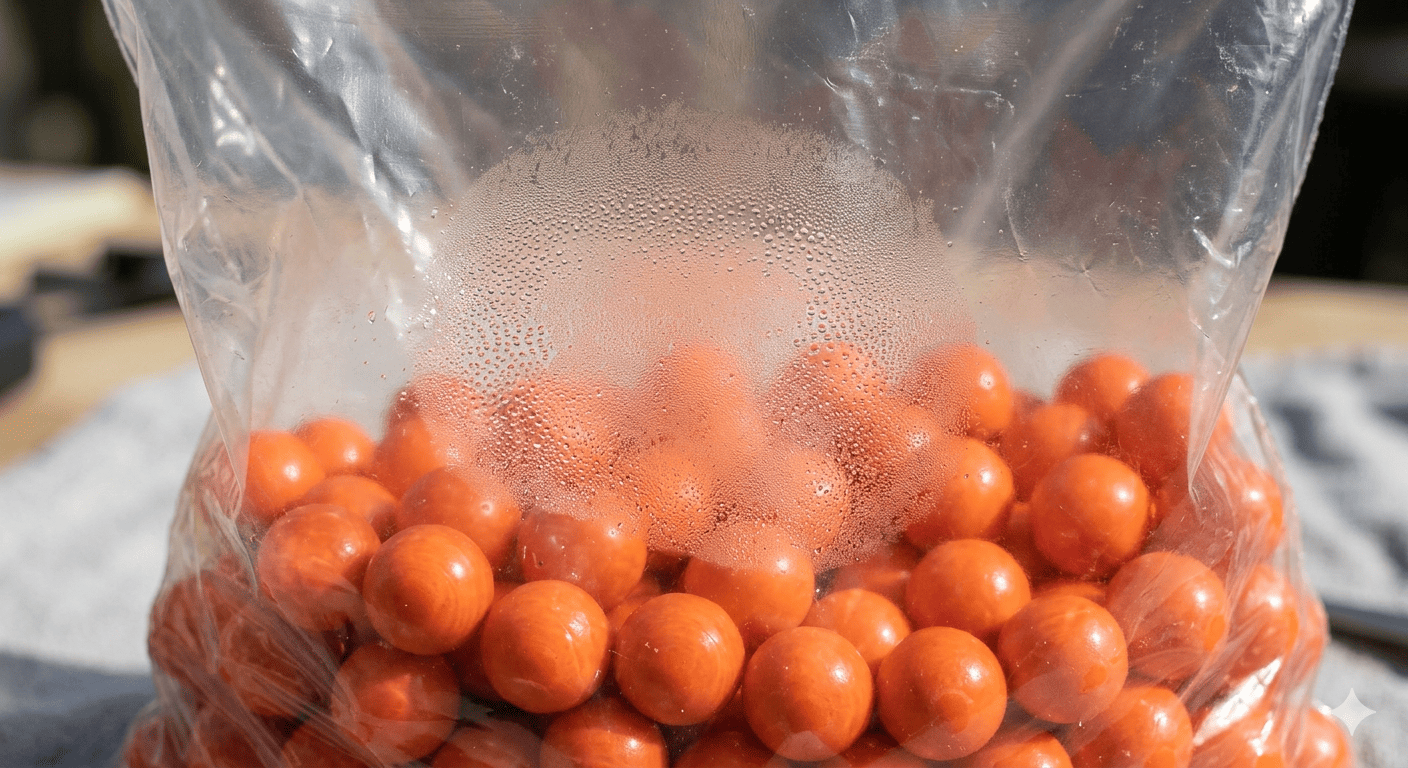
Industry-Wide IssueLiquid fill migrates through microscopic shell imperfections and appears as fogging, moisture droplets, or clear liquid pooling inside the bag. Can range from a faint misting on the interior bag surface to significant pooling of clear liquid. This is an industry-wide manufacturing reality, not a defect exclusive to any single supplier. Most common after 12+ months of storage, especially in temperature-variable environments. See Section 5 for the manufacturing explanation and how to assess affected batches.
Section 4: Fill Leakage — The Manufacturing Reality No One Explains
Of all the aging phenomena that field operators and importers encounter, fill leakage generates the most alarm and the most misplaced supplier complaints. It deserves a dedicated, honest explanation — because understanding it prevents both unnecessary product rejection and the deployment of genuinely damaged product.
What Leakage Looks Like
Leakage manifests in three progressive stages: (1) Misting — a fine haze or condensation-like moisture on the interior surface of the sealed bag, with no visible liquid pooling. (2) Droplet stage — visible small droplets of clear or slightly colored liquid on the bag interior and on ball surfaces. (3) Pooling — significant clear liquid accumulation at the bottom of the bag, with balls showing surface wetness and possible adhesion to each other.
Why It Happens: The Manufacturing Science
Paintballs are manufactured using softgel encapsulation technology. The gelatin shell forms a continuous membrane around the liquid fill, sealed at the seam during production. At the microscopic level, this membrane is not perfectly impermeable — it contains molecular-scale pathways through which small molecules can migrate, driven by concentration gradients and osmotic pressure.
PEG and water, being small hydrophilic molecules, are particularly mobile within the gelatin matrix. As the paintball ages, these molecules slowly migrate outward through the shell. The process accelerates when temperature fluctuates — each heating cycle causes the fill to expand, increasing internal pressure on the shell; each cooling cycle contracts the fill, creating slight negative pressure that draws moisture from the fill toward the shell surface. Over many cycles, this pumping action drives fill material progressively outward.
Research on micro-leakage in pharmaceutical softgel capsules — the manufacturing technology most analogous to paintball production — confirms that micro-leakage is an inherent characteristic of gelatin encapsulation, influenced by sealing temperature consistency, fill formulation, shell thickness, and storage conditions. It is a spectrum phenomenon — every softgel product exhibits some level of fill migration over sufficient time.
Is It a Defect or a Normal Phenomenon?
This is the question that generates most supplier disputes — and the honest answer requires nuance. Some degree of fill migration over extended storage (12+ months) is an industry-wide reality that no manufacturer can completely eliminate with current softgel technology. C-Star Technology, with over 20 years of production experience, confirms this is a known phenomenon across the paintball manufacturing industry — not an isolated quality failure from any single supplier.
What differentiates a manufacturing issue from a storage issue is the timeline and degree of leakage: leakage appearing within 3–4 months of production, or occurring in a large proportion of balls from a single batch, may indicate a production parameter problem (shell thickness, sealing temperature, fill-shell compatibility). Leakage appearing gradually after 12+ months in temperature-variable storage, affecting a minority of balls in a batch, is consistent with normal material aging.
Leakage is not proof of a bad factory. It is often proof of a long supply chain, a warm warehouse, and a product that behaved exactly as its chemistry predicted.
Section 5: How to Assess Affected Batches — The Field Operator’s Protocol
When you open a bag and find evidence of aging — flat spots, dimples, surface moisture, or leakage — the question is not “are these bad?” but “which of these are still usable, and how?” The answer is almost never binary.
The Three-Stage Assessment
Visual Inspection — Sort by Severity
Lay balls out on a flat surface and sort into three categories: (A) round with no visible deformation — proceed to touch test; (B) minor flat spots or light surface moisture — wipe and proceed; (C) significant dimpling, cracking, or pooled fill adhesion — set aside for further evaluation or discard. Visual roundness and surface integrity are the first indicators of remaining usability.
Touch Test — Hardness Assessment
Apply gentle finger pressure to each ball. Ideal: firm with slight give — like a firm grape. Too soft (deforms easily, feels squishy): high bounce risk, do not deploy for competitive use. Too hard (no give, feels like a marble): brittleness risk, high barrel-break probability. Balls passing the touch test proceed to the blow test.
Bore Test and Fire Test
Drop a ball vertically through your barrel. Should drop and stop, blown out by a light breath — neither falling freely (too small) nor stuck (too large from swelling). Then fire 10 rounds at cardboard from 15 feet. All 10 should break cleanly on impact. If 3 or more bounce, the batch has shifted beyond usable break threshold for field play. If 3 or more break in the barrel, the batch is too brittle for use.
Handling Leakage-Affected Batches Specifically
| Leakage Stage | What You See | Usability | Action |
|---|---|---|---|
| Stage 1 — Misting | Fine haze on bag interior; balls look normal | Generally Usable | Wipe balls with dry cloth. Run bore test and fire test. Deploy if tests pass. |
| Stage 2 — Droplets | Visible droplets on bag and ball surfaces; slight tackiness | Usually Usable | Wipe each ball thoroughly with dry cloth until surface is dry and non-tacky. Allow to air-dry briefly. Test before full deployment. Minor surface leakage does not compromise the shell if fill has not separated significantly. |
| Stage 3 — Pooling | Visible liquid at bag bottom; balls sticking together | Test Required | Separate sticking balls carefully. Wipe dry. Assess individual balls — some may pass tests. Balls that cannot be separated without damage, or that feel significantly lighter (fill loss), should be discarded. Remaining balls: test before use. |
| Stage 3+ — Extensive Damage | Large fill loss, shells collapsed or stuck irreversibly | Not Usable | Discard. Document batch number and storage conditions for supplier communication if appropriate. Evaluate whether storage conditions or transit contributed to the extent of damage before escalating to supplier. |
✅ The Dry Cloth Rule — C-Star Technology’s Field Guidance
Minor to moderate leakage (Stage 1 and Stage 2) does not automatically render paintballs unusable. A thorough wipe with a dry cloth removes surface moisture and residue, and balls that pass the subsequent bore test and fire test can be deployed for recreational field use without issue. The critical test is performance, not appearance. A ball that has mild surface condensation from PEG migration but passes the bore and fire test is functionally identical to a ball that has never leaked. The fill has not escaped — it has migrated to the surface.
Section 6: Special Consideration — Winter Formula Paintballs
Players and field operators in cold-weather regions often use winter formula paintballs — formulations designed to maintain normal use at lower temperatures. These balls noticeably more susceptible to aging-related deformation.
- Flat points develop faster and more visibly in winter formula paint due to softer gelatin — even slight contact pressure over weeks creates noticeable deformation.
- Dimples are more pronounced from humidity exposure, as the softer shell offers less structural resistance to moisture-driven swelling at contact points.
- Leakage may appear earlier — typically after 8–10 months in variable temperature storage, rather than 12+ months for standard formula.
- Rotation is more important: winter formula bags should be rotated every 1–2 weeks rather than the standard 2–3 week interval to reduce contact-point deformation.
- Stock winter formula conservatively — order quantities sufficient for the cold-weather season without creating carry-over inventory that must be stored through warm months.
Section 7: Practical Inventory Management for Field Operators and Importers
Knowing the aging timeline and failure modes, the operational objective is straightforward: structure your procurement and storage practices so that paintballs reach the game field before quality degradation becomes a performance or safety issue.
For Field Operators
- Target inventory depth of 2–3 months of projected usage at any time. This keeps stock rotating through the peak-performance window and prevents accumulation of aging inventory.
- FIFO without exception. Label every case with arrival date. The oldest stock goes to the field first — never new stock over old.
- Inspect every incoming shipment on receipt day. Document the baseline quality of each batch with photos. This establishes the starting point and protects you in any subsequent supplier quality discussion.
- Pre-game quality check every session — visual, touch, and bore test on 5–10 balls from each bag before loading. This is the last line of defense between aging stock and a session of barrel breaks.
- Communicate storage requirements to your distributor. If your distributor is storing paintballs in non-climate-controlled conditions before shipping to you, their storage time is part of your total aging clock.
For Importers and Trading Companies
- Calculate total supply chain time from production to field deployment — factory production → export preparation → ocean transit (30–45 days typical) → customs clearance → warehouse storage → distribution → field use. In many cases this total exceeds 4–6 months before the product is ever played with. Plan procurement accordingly.
- Request production date (not just shipment date) from your manufacturer. The shelf life clock starts at production, not at your receiving dock.
- For shipments over 90 days in transit plus storage: include desiccant packets in case layers, specify insulated container wrapping for summer shipments, and pre-agree with the manufacturer on quality documentation at time of production.
- When leakage complaints arise from your downstream customers: before escalating to the manufacturer, assess the total time elapsed since production and the storage conditions in the supply chain. If the combined time exceeds 12–18 months in non-ideal conditions, the probability of storage-driven leakage is high and the resolution conversation with the manufacturer should be framed accordingly.
- Establish clear quality benchmarks with your manufacturer — agreed acceptable limits for flat point frequency, leakage rate per batch, and out-of-round tolerance. These benchmarks create an objective baseline for quality discussions and prevent subjective complaints from either party.
⚠️ The Supplier Communication Principle
Most paintball quality complaints that reach manufacturers are legitimate storage or transit problems presented as manufacturing defects. This creates adversarial supplier relationships, delayed resolutions, and missed root causes. The better approach: before contacting your supplier about any quality issue, document the production date, the storage conditions across the entire supply chain, and the time elapsed. If the honest answer involves a 9-month supply chain in sub-optimal conditions, the conversation with your manufacturer becomes a collaborative problem-solving discussion rather than a blame exercise — and you are more likely to get practical assistance, not defensiveness.
✅ The Complete Answer: Do Paintballs Go Bad Over Time?
Yes — and the rate is determined by storage, not by a fixed calendar date. In ideal conditions (59–77°F, 40–50% RH, sealed, dark, rotated), paintballs from an experienced manufacturer like C-Star Technology. In typical field or import supply chain conditions, the practical peak-performance window is 6–9 months, with acceptable recreational performance extending to 12–18 months.
The quality changes that occur — flat points, dimples, shell softening or brittleness, fill separation, and leakage — are predictable, gradual, and mostly manageable with systematic assessment protocols. Leakage specifically is an industry-wide manufacturing reality for long-stored product, not an automatic quality disqualifier. A dry-cloth wipe and a performance test tell you whether affected balls are still field-deployable — and in many cases, they are.
The operators who manage this best are not those who assume paintballs are either perfect or ruined. They are the ones who know what to look for, what each symptom means, and how to make a confident, informed decision about every batch before it reaches the game field.