
Paintball Shell Thickness vs Shell Hardness: What Is the Difference?
A factory quotes a shell thickness of 0.032 inches and a hardness of Shore A 55. A buyer knows these numbers are good, but cannot explain what each one actually controls. Is a thicker shell always better? Is harder always more reliable? The answers require understanding the difference between a dimensional measurement and a material property.
This guide explains the difference between paintball shell thickness and paintball shell hardness, how each is measured, how they interact, and what combinations work best for different types of play.
Overview Two different properties, one paintball
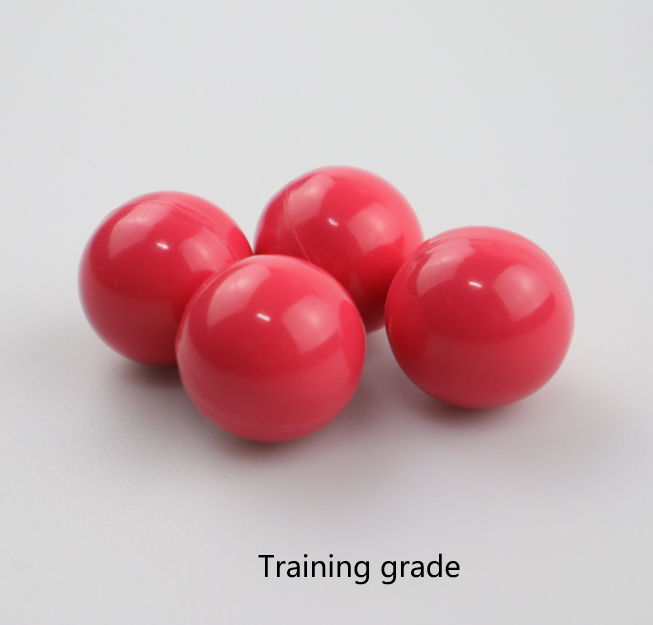
Thickness and hardness are independent. A shell can be thin and soft, thick and hard, or any combination in between. Both properties together determine how the paintball performs on impact.
Thickness Shell thickness: what it is, how it is controlled
Shell thickness is the physical measurement of the gelatin wall, typically measured at the equator of the painted ball after cutting it in half. The thickness determines how much material must fracture for the shell to break.
How it is controlled: The gap between the mold cavity and the mandrel determines the shell thickness. Precision molds hold this gap within 0.001 inches of the target. Injection pressure and gelatin viscosity also affect how the gelatin flows and sets, which influences the final thickness distribution.
Effects on performance: Thinner shells (0.030-0.033 inches) break more easily on impact but are more fragile in the breech and during handling. Thicker shells (0.034-0.038 inches) are more durable but require higher impact velocity to break, increasing the risk of bouncing on soft targets.
Hardness Shell hardness: what it is, how it is measured
Shell hardness is the material stiffness of the gelatin, measured on the Shore A durometer scale. The durometer presses a small indentor into the shell surface and measures the resistance. A reading of Shore A 45-50 is relatively soft, 50-60 is medium, and 60-65 is hard.
How it is controlled: Gelatin bloom strength (150-300 bloom) is the primary determinant of hardness. Higher bloom gelatin produces harder shells. Plasticizer content (glycerin and sorbitol) softens the shell. Curing conditions (temperature, humidity, duration) also affect final hardness. Manufacturers adjust these parameters to achieve the target hardness.
Effects on performance: Harder shells (Shore A 55-65) are more brittle and break more easily on impact. Softer shells (Shore A 45-55) are tougher and more likely to deform or bounce on impact. However, very hard shells can also be more prone to cracking in the breech or during handling.
Interaction How thickness and hardness interact
The combination of thickness and hardness determines the overall break behavior. Here is how different combinations perform:
| Thickness | Hardness | Break Behavior | Best Use |
|---|---|---|---|
| Thin (0.030) | High (Shore A 55-60) | Breaks easily, clean fracture | Tournament play |
| Thin (0.030) | Low (Shore A 45-50) | Deforms, may bounce | Not recommended |
| Medium (0.033) | Medium (Shore A 50-55) | Balanced break reliability | Premium field grade |
| Thick (0.036) | High (Shore A 55-60) | Tough, bounce-prone | Practice / reball |
| Thick (0.036) | Low (Shore A 45-50) | Soft, deforms, barrel breaks | Not recommended |
The ideal combination for tournament play is thin shell (0.030-0.033 inches) with moderately high hardness (Shore A 55-60). This combination provides clean breakage at standard velocities while maintaining enough structural integrity for reliable feeding and firing.
Grades Typical specifications by grade
| Grade | Shell Thickness | Shell Hardness | Target Behavior |
|---|---|---|---|
| Tournament | 0.030-0.033″ | Shore A 55-60 | Clean break, low bounce |
| Premium field | 0.032-0.035″ | Shore A 50-55 | Balance of durability and break |
| Standard field | 0.034-0.038″ | Shore A 50-55 | Durable, good for rental markers |
| Cold weather | 0.032-0.035″ | Shore A 55-65 | Compensates for cold softening |
| Heat tolerant | 0.030-0.033″ | Shore A 55-60 | Resists softening in heat |
Buyers What buyers should specify
When ordering OEM or private label paintballs, specify both thickness and hardness targets in your quality agreement:
- Shell thickness. Specify the target thickness and acceptable tolerance. Example: 0.032 inches +/- 0.002 inches for tournament grade.
- Shell hardness. Specify the target Shore A range. Example: Shore A 55-60 for tournament grade.
- Measurement method. Specify how each is tested: cut and measure thickness with micrometer or caliper; measure hardness with Shore A durometer at the shell equator.
- Sampling frequency. Specify how many balls per batch are tested. Standard: 5 balls for thickness, 10 balls for hardness.
? Frequently Asked Questions
Can I measure shell hardness without a durometer?
A rough field test: press your thumbnail into the shell surface. A hard shell (Shore A 55+) resists indentation noticeably. A soft shell (Shore A 45-50) indents easily. This is not precise, but it gives a quick comparison between different batches. For accurate measurements, a Shore A durometer costs $50-150 and is worth the investment for serious quality control.
Does shell hardness change over time?
Yes. As paintballs age, the gelatin continues to crosslink, which can increase hardness over time. Temperature and humidity also affect hardness. A paintball stored at 75F and 50% humidity maintains its original hardness longer than one stored at 90F or 80% humidity. This is why storage conditions affect break reliability even when the shell thickness remains unchanged.
Does fill type affect perceived shell hardness?
No. The fill does not affect shell hardness because the fill is inside the shell and does not change the gelatin material properties. However, fill weight and viscosity affect how the ball behaves on impact, which can be perceived as a hardness difference. A heavy fill ball may break differently from a light fill ball even if the shell hardness is identical.
Which parameter is easier for manufacturers to control consistently?
Shell thickness is generally easier to control because it is determined by the mold gap, which is a fixed mechanical setting. Shell hardness is more variable because it depends on gelatin bloom strength (a natural product with lot-to-lot variation), plasticizer concentration, and curing conditions. Premium manufacturers invest in raw material testing and process control to maintain consistent hardness.
+ The short version
Shell thickness is a dimensional property (how thick the wall is, measured in inches). Shell hardness is a material property (how stiff the gelatin is, measured on the Shore A scale). They are controlled by different manufacturing parameters and affect break reliability in distinct ways.
The ideal combination for tournament play is thin shell (0.030-0.033 inches) with moderately high hardness (Shore A 55-60). For field-grade paint, medium thickness (0.034-0.038 inches) with medium hardness (Shore A 50-55) provides a good balance of durability and break reliability. Specify both parameters when ordering OEM paintballs and verify them with your own testing.
Need help specifying shell properties for your paintball order? Contact CS Paintballs for detailed shell thickness and hardness specifications across all product grades.