
Paintball Tank Exploded? The Real Danger of Using the Wrong Lubricant
It started like any routine maintenance day at a busy paintball field in Georgia. A technician grabbed the nearest can of oil from the supply cabinet — something that looked perfectly reasonable — and serviced a row of rental HPA tanks. Within hours, a regulator failed catastrophically. The tank didn’t just leak. It exploded.
This is not a horror story invented to sell products. Incidents like this are documented in U.S. Consumer Product Safety Commission (CPSC) recall and incident databases, and they share a single, entirely preventable root cause: the wrong lubricant on a high-pressure paintball tank.
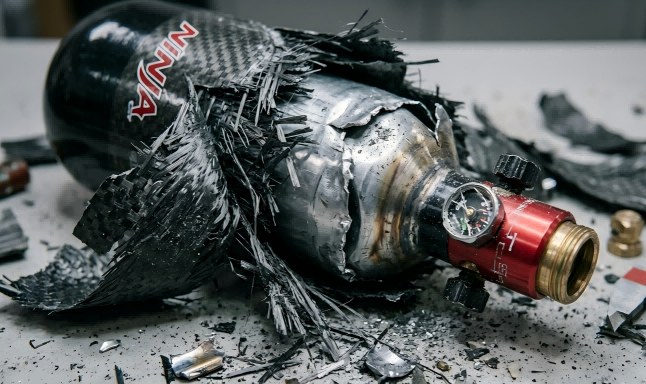
Why the Wrong Lubricant Turns Your Tank Into a Bomb
To understand the danger, you need a quick lesson in pressure-driven oxidation chemistry — and it’s simpler than it sounds. Most paintball HPA tanks are filled with breathable compressed air (approximately 78% nitrogen, 21% oxygen). CO₂ tanks, while not oxygen-rich in the same way, still operate at pressures between 800–1,800 PSI at typical field temperatures.
When you introduce a petroleum-based lubricant (mineral oils, WD-40, 3-in-1 oil, gun oil, motor oil, or standard aerosol lubricants) into this environment, two dangerous processes are set in motion:
1. Diesel Effect (Adiabatic Compression Ignition)
When a regulator or valve opens rapidly, compressed gas is forced through a small orifice at extremely high velocity. This sudden compression causes a rapid and dramatic temperature spike — the same thermodynamic principle that makes a diesel engine fire without a spark plug. If petroleum-based hydrocarbon residue is present in that pathway, the combined heat and oxygen can ignite it instantaneously. This is called adiabatic compression ignition, and it is the leading cause of oxygen-system fires in industrial and recreational gas equipment.
2. O-Ring Degradation and Sudden Seal Failure
Your paintball tank’s O-rings are the only thing standing between a controlled high-pressure system and a catastrophic rupture. Most are made from Buna-N (nitrile), EPDM, or Viton rubber compounds. Petroleum-based oils chemically attack nitrile and EPDM rubber, causing the O-rings to swell, soften, and eventually disintegrate. Once the primary seal fails at 3,000–4,500 PSI, the result isn’t a gentle hiss — it’s a pressure explosion that can send fragments of metal and carbon fiber at lethal velocity.
This mechanism is so well-established that the ASTM International Standard F1108 (Standard Specification for Paintball Markers) and the U.S. DOT Pipeline and Hazardous Materials Safety Administration (PHMSA) regulations for pressurized cylinders both explicitly prohibit petroleum-based lubricants in high-pressure air and CO₂ service environments.
Safe vs. Dangerous Lubricants: The Complete Comparison Guide
This is the table every paintball field owner should print and post in their maintenance area. The distinction between safe and unsafe lubricants is not a matter of brand preference — it is a matter of chemical compatibility with high-pressure oxygen-containing systems.
| Product | Base Chemistry | Safe for HPA Tanks? | Safe for CO₂ Tanks? | O-Ring Impact | Risk Level |
|---|---|---|---|---|---|
| Christo-Lube MCG 111 | PTFE / Fluorinated | ✅ YES | ✅ YES | Conditions & protects | Approved |
| Dow Corning Molykote 111 | Silicone-based | ✅ YES | ✅ YES | Conditions & protects | Approved |
| Parker Super O-Ring Lube | Silicone-based | ✅ YES | ✅ YES | Neutral / protective | Approved |
| WD-40 (any variant) | Petroleum / mineral oil | 🚫 NO | 🚫 NO | Degrades nitrile & EPDM | EXTREME |
| 3-in-1 Oil | Petroleum-based | 🚫 NO | 🚫 NO | Swells & softens rubber | EXTREME |
| Motor Oil / Engine Oil | Petroleum-based | 🚫 NO | 🚫 NO | Rapidly degrades seals | EXTREME |
| Gun Oil (e.g., Rem-Oil, Ballistol) | Petroleum / mineral oil | 🚫 NO | 🚫 NO | Degrades O-rings | HIGH |
| Vaseline / Petroleum Jelly | Petroleum-based | 🚫 NO | 🚫 NO | Swells nitrile O-rings | HIGH |
| Dry PTFE Spray (e.g., DuPont Teflon) | PTFE with carrier solvent | ⚠️ Depends on carrier | ⚠️ Depends on carrier | Neutral when dry | Verify carrier agent |
The Paintball Field Owner’s Tank Maintenance Protocol
Running a commercial paintball field means you are responsible for the safety of dozens of players every single day. The liability exposure from a tank-related injury — let alone a fatality — is existential for your business. Here is the minimum-standard maintenance protocol you should implement and document:
Before Every Rental Session
- Visually inspect every tank for dents, cuts, abrasions, bulging, or corrosion
- Check that hydrostatic test date is not expired (see below)
- Confirm regulator output pressure is within spec (typically 800–850 PSI for HPA paintball rentals)
- Listen for audible leaks around regulator and burst disc
- Never fill a tank that has been dropped hard, shows visible damage, or has an expired hydro date
- Never use a fill station that lacks a proper bleed valve and pressure gauge
Monthly Deep Maintenance
- Remove regulator and inspect O-rings under magnification for cracking, swelling, or flattening
- Replace O-rings using only manufacturer-specified materials (Buna-N, Viton, or EPDM as specified)
- Apply one small pea-sized amount of Christo-Lube MCG 111 or Dow Molykote 111 to each O-ring
- Inspect burst disc for deformation — replace if any doubt exists
- Log every maintenance action with date, tech name, and parts replaced
- Never re-use a burst disc that has been pressurized past its rated limit
Hydrostatic Testing Schedule
Per U.S. DOT 49 CFR Part 180 and the guidelines published by the compressed gas cylinder industry:
- Carbon fiber HPA tanks: hydro-test every 3 years, retire after 15 years from manufacture date
- Aluminum HPA tanks: hydro-test every 5 years, retire per manufacturer spec (typically 15 years)
- Steel CO₂ tanks: hydro-test every 5 years
- Send tanks to a CGA-certified hydrostatic testing facility — do not attempt in-house testing
- Never fill or use a tank with an expired hydrostatic test date — this is also a DOT violation subject to fines
What Actually Happens When a Paintball Tank Explodes: Real-World Cases
Understanding the mechanics is important. But nothing drives home the urgency like documented incidents. While paintball-specific fatalities from tank explosions are relatively rare compared to the millions of tank-hours logged annually, the injuries that do occur are severe and the legal consequences for field operators are significant.
The CPSC’s incident database and the NFPA 55 Compressed Gases and Cryogenic Fluids Code document recurring patterns in pressurized cylinder incidents across recreational and industrial applications:
- Regulator blow-off events: The most common outcome of O-ring failure — the regulator separates from the tank body at pressure, becoming a ballistic projectile
- Burst disc rupture: When lubricant contamination degrades internal components, pressure builds unevenly and overwhelms the burst disc, releasing stored energy in a single violent event
- Carbon fiber delamination explosion: Petroleum contamination of CF-wrapped tanks weakens the epoxy matrix over time, leading to catastrophic structural failure during a fill cycle
- Fill station backfire: Contaminated tanks can introduce hydrocarbon residue into fill station lines, creating a combustion risk at the fill station itself — endangering the fill operator
Building a Safety-First Culture on Your Paintball Field
Equipment protocols only work when your entire team understands and follows them. Field owners who treat tank maintenance as a one-person responsibility are one staff turnover away from a dangerous gap. Here’s how to build institutional safety knowledge that persists regardless of who is on shift:
Create a Locked Maintenance Supply Station
Keep approved lubricants (Christo-Lube, Dow Molykote 111) in a clearly labeled, locked cabinet. Post a laminated “DO NOT USE” list showing photographs of banned products. Remove all petroleum-based products from your maintenance area entirely — if WD-40 isn’t there, it can’t be accidentally used.
Implement a Two-Person Verification Rule for Tank Service
Any time a regulator is serviced or O-rings are replaced, require a second person to verify the correct lubricant was used before the tank is returned to rental inventory. Document the verification in your maintenance log. This simple redundancy catches mistakes before they reach players.
Train New Staff with Hands-On Demonstrations
Abstract warnings don’t stick. Show new staff the physical difference between an O-ring soaked in petroleum lubricant (swollen, tacky, degraded) and a properly maintained O-ring. The PBNation Technical Forum and Reddit r/paintball contain extensive community knowledge — but for formal training, look to the Safety Gear Auditing & Underwriting Services (SGAUS) and manufacturer training resources from brands like Ninja Paintball and Guerrilla Air.
🛡️ Protect Your Field. Protect Your Players.
Browse our full range of approved paintball tank lubricants, O-ring kits, and maintenance supplies — everything your field needs to stay safe and compliant.
Shop Approved Maintenance Supplies →Frequently Asked Questions: Paintball Tank Safety & Lubricants
The Bottom Line: No Shortcut Is Worth a Life
Running a paintball field is a balancing act of customer experience, operational efficiency, and cost control. It’s tempting to grab whatever lubricant is on the shelf when a regulator needs a quick service between games. But the chemistry is unforgiving: a petroleum-based lubricant in a high-pressure paintball tank system is not a minor protocol violation — it is a loaded weapon pointed at your players, your staff, and your business.
The approved alternatives — Christo-Lube MCG 111, Dow Molykote 111, and silicone-based O-ring lubricants — cost a few dollars per tube and last hundreds of service cycles. The cost of getting it wrong is measured in lawsuits, injuries, and lives. There is no ambiguity in this calculation.
Build your maintenance protocols around approved lubricants, document every service action, keep your hydro test dates current, and train every staff member who touches a tank. The paintball industry’s excellent long-term safety record exists because most operators do these things right. Make sure your field is one of them.
For additional guidance on compressed gas cylinder safety standards, visit the Compressed Gas Association (CGA) and the NFPA 55 Compressed Gases Code. For paintball-specific technical community support, the PBNation community forums remain one of the industry’s most comprehensive technical resources.