
Private Label Paintballs: Build Your Own Brand from the Ground Up
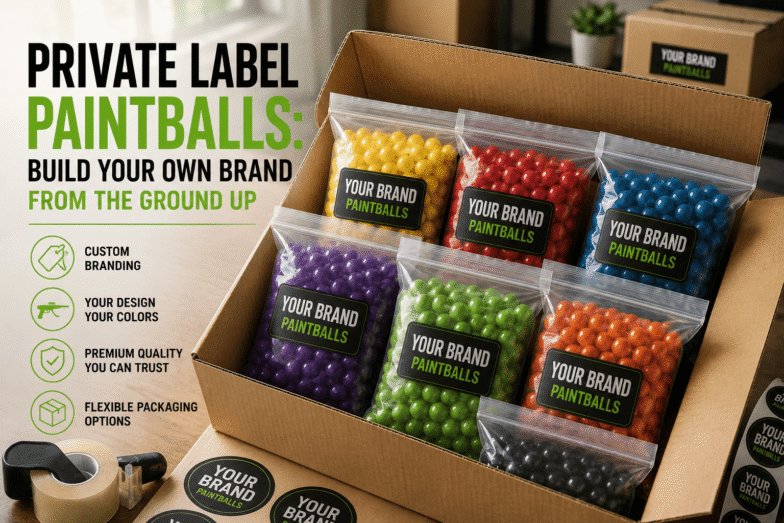
Walk into the pro shop at almost any established paintball field in the US or Europe and you will see two tiers on the shelf: national brands on one side, and the field’s own brand on the other. The field brand often sells for a dollar or two less per case, but it carries a better margin for the field owner because the middleman has been cut out.
That is the private label model in its simplest form, and it is more accessible than most field owners and distributors realize. Private label paintballs are manufactured by a factory that already produces paintballs at scale, packaged in cases printed with your logo, your colors, and your product name. The factory handles the production. You own the brand.
What private label means in the paintball industry
Private labeling sits between buying unbranded white-label paint and developing a proprietary product from scratch. You do not design the paintball formulation or build a production line. You specify the branding and packaging, and the factory delivers a finished product that looks like it came from your company.
The scope of private labeling ranges from simple (your logo on a standard case of standard-yellow paint) to comprehensive (custom case design + custom fill color + custom box dimensions + branded tape). Most private label buyers land somewhere in the middle: a full-color printed case with their logo and a custom fill color in their brand palette.
The case for going private label
Three business drivers push field owners and distributors toward private label paintballs. At least one of them probably applies to you.
What is included in a private label package
A standard private label arrangement from an established paintball manufacturer includes:
- Case printing: Full-color, multi-side printing on standard corrugated cases. Your artwork, your product name, your logo. Most manufacturers offer a design template and can work with your existing brand assets.
- Case labeling: If full-case printing is not in your budget, many manufacturers offer label-only options where a high-quality adhesive label is applied to a standard case. Lower upfront cost, still clean-looking.
- Custom fill color (optional): Paintballs filled with a color that matches your brand palette. Covered in our previous guide on custom color paintballs.
- Quality guarantee: The paint inside the case should meet the same QC standards as the manufacturer’s own brand. This is non-negotiable and should be documented in your agreement.
- Packaging consistency: Case dimensions, pallet configuration, and shrink-wrapping that matches your logistics requirements.
Costs, MOQ, and lead times
| Item | Typical Cost | Notes |
|---|---|---|
| Per-case premium (vs unbranded) | 5–15% | Higher for custom fill + case combos |
| Case artwork setup fee | $200–$800 | Plate making + design prep; one-time per SKU |
| Color match sample (if custom fill) | $50–$200 | May be waived on first order |
| MOQ (standard fill + case print) | 200–500 cases | Lower for label-only option |
| MOQ (custom fill + case print) | 300–500 cases | Higher due to fill line purging |
| Lead time (artwork to production) | 1–2 weeks | Faster if artwork is print-ready |
| Lead time (production) | 3–5 weeks | Depends on factory schedule |
How to choose the right manufacturing partner
Your private label brand is only as good as the paint inside the case. The wrong manufacturer will deliver inconsistent quality that damages the brand you are trying to build. Here is what to look for:
The process: from concept to container
The private label workflow follows a predictable sequence. Understanding each stage helps you plan your timeline and avoid surprises.
- Brand scoping. Define your product name, brand colors, target price point, and quality tier (field grade or tournament grade). Estimate your initial order volume.
- Manufacturer qualification. Vet 2-3 factories using the criteria above. Request sample cases of their standard product and evaluate quality before discussing private label terms.
- Artwork and design. Work with a designer (or use the manufacturer’s design service) to create case artwork. The manufacturer provides a template with bleed lines, fold lines, and label areas. Expect 1-2 rounds of revisions.
- Color matching (if custom fill). Order a color match sample of the fill and a printed case proof simultaneously to save time.
- Production. Once artwork and color are approved, the factory schedules your run. Production takes 3-5 weeks depending on the factory’s current load.
- Pre-shipment sampling. Request a sample from the production run before the container is sealed. Verify case print quality, fill color, and paint performance.
- Shipping and launch. The container ships. Use the transit time to prepare your marketing materials, train your staff, and plan your launch.
Three signs you are ready to launch your own brand
Private labeling is not right for every field or distributor. Here are three indicators that the timing is right for you.
Frequently Asked Questions
Can I start with just a case label instead of full-case printing?
Yes. Many manufacturers offer a label-only entry point where a custom-printed adhesive label is applied to a standard case. This reduces the setup cost significantly (no plate making) and allows you to test the market before committing to full-case printing for a larger MOQ.
Will the paint quality be the same as the manufacturer’s own brand?
It should be, and you should verify this in writing. The manufacturer should use the same shell formulation, same fill recipe, and same QC protocols for your private label run as they use for their own brand. If they offer a lower-quality formulation for private label, that is a dealbreaker.
Can I order private label from a manufacturer that is not in China?
Most private label paintballs are manufactured in China because that is where the global paintball manufacturing infrastructure is concentrated. There are small-scale manufacturers in the US and Europe, but their per-case costs and MOQs are significantly higher. China offers the best combination of quality, cost, and capacity for private label.
How do I protect my brand if I switch manufacturers later?
Own your case artwork files, own your Pantone color specifications, and own your product name trademark. The intellectual property should be yours, not the manufacturer’s. A reputable manufacturer will provide print-ready files and color formulas. Non-disclosure and non-compete agreements are standard in this industry.
The short version
Private labeling paintballs is one of the most effective ways for a field or distributor to build brand equity, improve margins, and create customer loyalty. The process is well-established, the investment is modest, and the risk is low when you choose the right manufacturing partner.
The key is treating private label as a brand-building exercise, not just a packaging change. Every case with your logo on it is a marketing impression. Every player who shoots your paint and has a good experience becomes a brand advocate. That compounds over time in ways that per-case margin alone cannot capture.
Ready to discuss private label paintballs for your brand? Contact CS Paintballs to request artwork templates, pricing, and current MOQ for private label runs.