
Do Rubber Balls Hurt More Than Paintballs?
The physics, the injury data, the player experience, and why the “cheaper reusable alternative” is neither cheaper nor safer in a live game context.
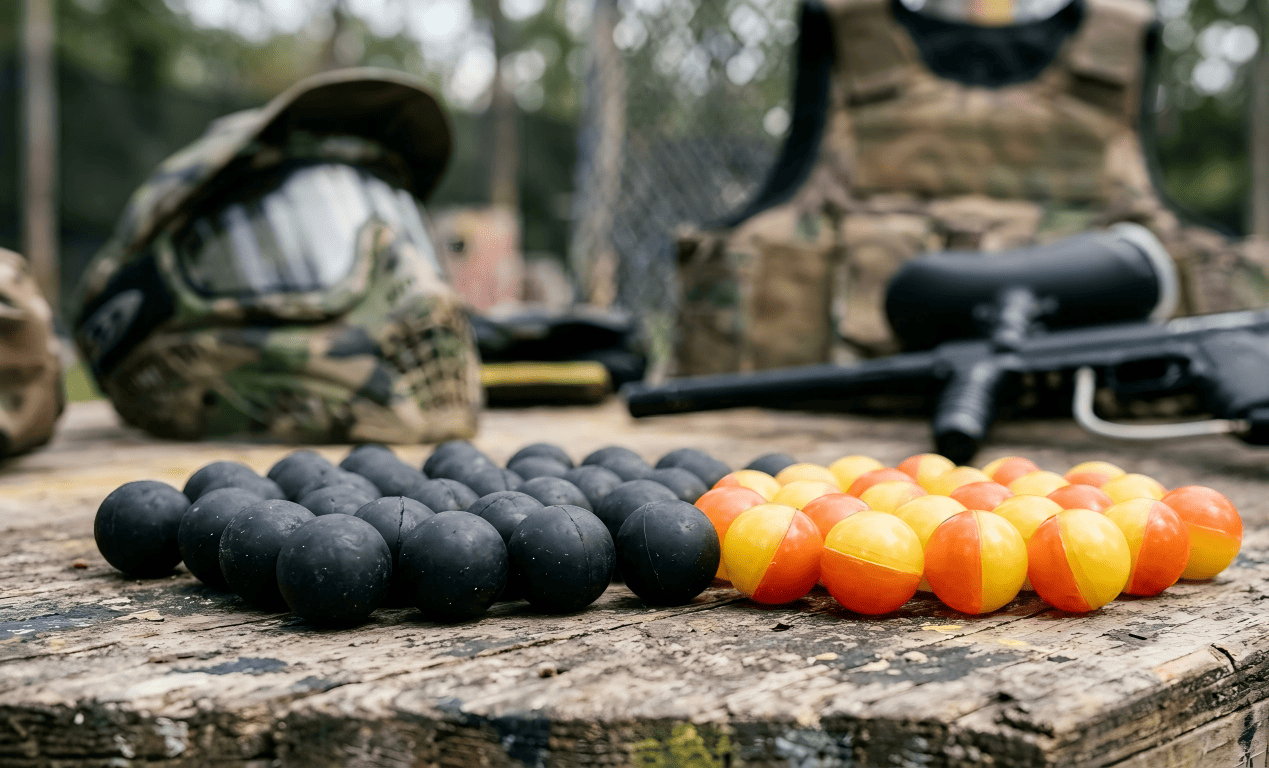
The idea seems appealing on the surface: rubber balls are reusable, they don’t leave paint everywhere, and they look like they’d be lighter and safer than a paintball. The reality is the opposite. Rubber balls — especially solid rubber balls — deliver significantly more injury risk than paintballs, cause more severe bruising, cannot produce the color-mark hit confirmation that makes paintball worth playing, and have a legitimate use case primarily in static target shooting, not live player-versus-player competition. This guide breaks down exactly why, using physics, peer-reviewed injury data, and real player experience.
Yes — rubber balls hurt significantly more than paintballs, and pose substantially greater injury risk. A solid rubber ball transfers 100% of its kinetic energy to the target on impact. A paintball absorbs a portion of its energy during shell rupture. At equal velocity and mass, a non-breaking projectile always delivers more pain and more tissue damage than one that breaks on contact. Solid rubber balls are heavier than paintballs, amplifying the energy differential further. This is not opinion — it is the physics of elastic vs. inelastic collision.
Section 1: The Physics — Why Breaking on Impact Reduces Pain
The fundamental mechanism that makes paintball a safe recreational sport is the same one that makes rubber balls dangerous in a live-game context: what happens to kinetic energy at the moment of impact.
Kinetic energy at impact is calculated as:
KE = ½ × m × v²
When a paintball strikes a player and its shell ruptures, a portion of the kinetic energy is consumed in the rupture process itself — deforming and fragmenting the gelatin shell, dispersing the fill material outward, and converting mechanical energy into heat and sound. The energy transferred to the player’s body is meaningfully reduced. This is the physics equivalent of a water balloon: the balloon that bursts on impact hurts far less than one that bounces off at the same speed.
A solid rubber ball undergoes elastic collision — it rebounds without deforming. In elastic collision, energy transfer to the target is maximized, not reduced. As the paintball player community has documented empirically for decades: “The physical action of a ball breaking will consume a small amount of potential energy resulting in less feel/pain. Whereas a ball that bounces will transfer all of its potential energy to whatever it hits. Namely, you.”
The difference is not marginal. The energy absorbed by shell rupture in a standard .68 cal paintball at 280 fps accounts for a meaningful fraction of total impact energy — enough to determine whether a hit produces a brief sting or a significant bruise, whether protective gear absorbs the remainder comfortably or transmits concentrated force through it.
The Mass Problem: Rubber Balls Are Heavier
 Compounding the elastic collision problem is mass. A standard paintball weighs approximately 3.0–3.2 grams. A solid rubber ball of equivalent diameter (.68 cal / 17.3mm) weighs significantly more — solid rubber spheres of this diameter typically weigh 6–10 grams depending on rubber density, representing 2–3× the mass of a paintball. Since kinetic energy scales with mass, a solid rubber ball fired at the same velocity carries 2–3× the kinetic energy before the elastic collision advantage compounds the differential further.
Comparative impact energy at typical field velocities (relative scale):
Note: US Army Human Engineering Laboratory identified severe bodily damage threshold at approximately 120 joules for a 1-inch rubber sphere. Source: LegalClarity / ResearchGate
Section 2: What the Injury Data Shows
Rubber projectiles are not theoretical curiosities — they have a documented medical literature because law enforcement has used rubber bullets for crowd control for decades, generating clinical evidence of exactly what rubber projectiles do to the human body at various velocities and ranges.
A peer-reviewed case report published in PMC (PubMed Central) documenting thoracic injuries from rubber projectiles confirms the core mechanism: “When a projectile strikes a person, its kinetic energy at impact is defined by its mass and its velocity (½ × mass × velocity²). Ballistic studies suggest that a projectile needs to apply a threshold energy density of greater than 0.1 J/mm² to skin in order to penetrate and cause internal injuries.” The study documents cases of penetrating chest injury from rubber projectiles — injuries that required surgery.
A Swiss review of kinetic impact projectile regulation confirms the ocular injury threshold data that makes rubber balls particularly dangerous around the face: “KIPs were originally cleared for use in crowd control at kinetic and area-normalised energies assumed to lie below the threshold for ocular penetration. However, closed globe injuries suffice to cause permanent visual loss.” The review explicitly notes that lower energy thresholds for lasting damage have been confirmed by newer literature — including data from paintballs and toys — meaning even relatively low-energy rubber projectiles can cause permanent eye damage if they strike unprotected eyes.
🚨 The Eye and Face Injury Risk
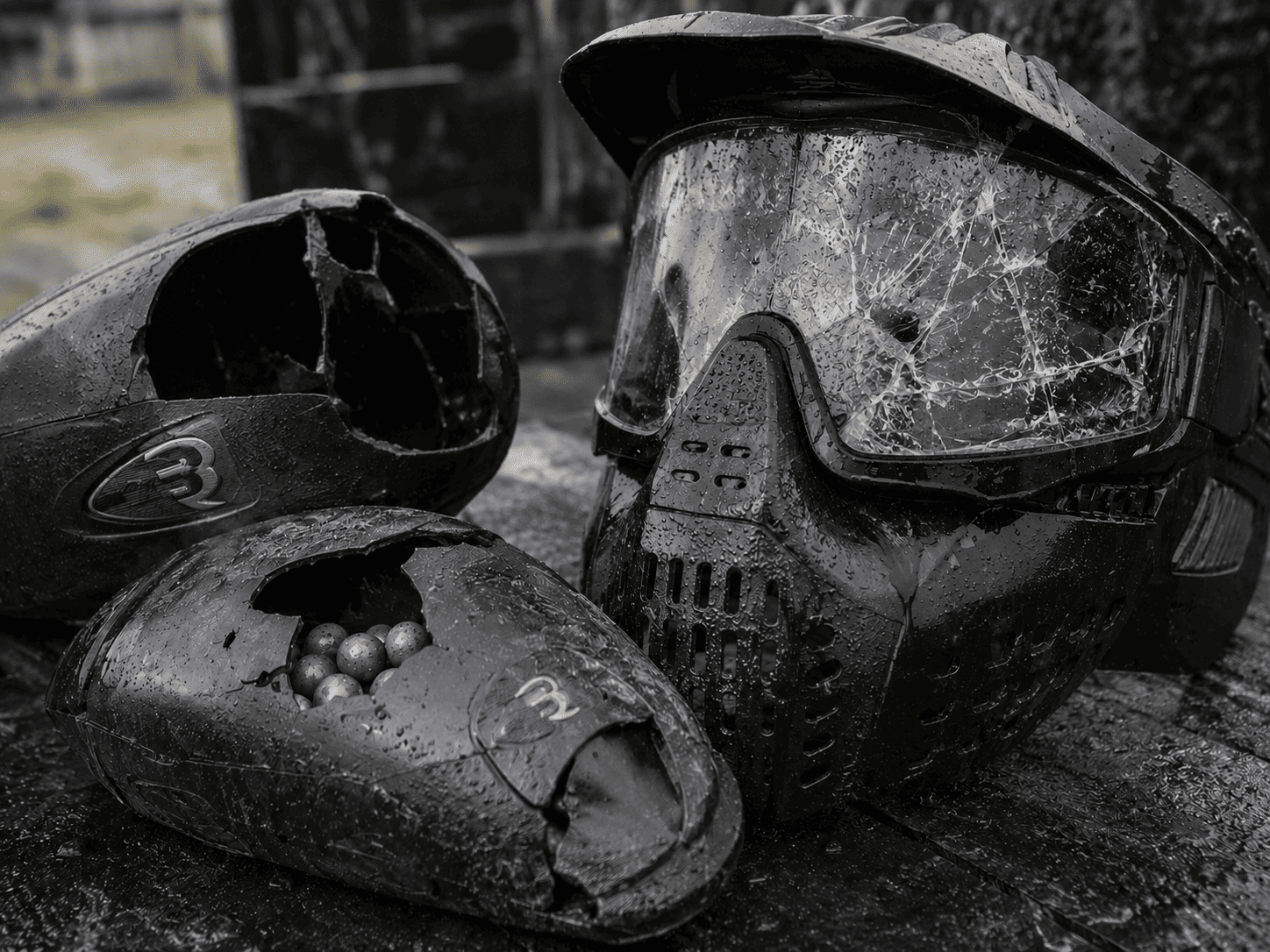
Standard paintball masks are rated and tested specifically for the impact energy delivered by paintballs at field velocities. A solid rubber ball fired at the same FPS delivers 2–3× the impact energy — meaning it can exceed the rated protection threshold of standard paintball face protection. There are documented cases of rubber projectiles cracking or penetrating paintball-grade face shields when fired at standard paintball velocities. This is not a theoretical risk — it has happened. A rubber ball that defeats a player’s mask can cause permanent eye injury or facial bone fractures. No field safety protocol accounts for this because no legitimate field uses solid rubber balls in live competition.
Section 3: What Players Actually Report — Community Experience
Beyond the physics and medical literature, the paintball player community has extensive real-world experience with reusable rubber-type projectiles — primarily through ReBall (a commercial reusable paintball alternative) — and the consensus is consistent:
“Reballs hurt more. You know how when a paintball bounces off of you but doesn’t break, it hurts more? I can’t explain exactly why, but it usually does. Well, this is basically what would be happening with each shot from a ReBall. They say you should turn your velocity down when using ReBalls — to 220fps or 250fps.”
“Yea, it’s like getting hit with a ball of ice or a water balloon — both the same weight, but one doesn’t hurt as bad because it is being dispersed as it breaks.”
The patent for a reusable hollow-sphere paintball alternative explicitly states: “Because of its reduced mass, the projectile possesses and transmits a lower amount of kinetic energy, and therefore inflicts less pain and damage upon impact compared to conventional paintballs and reusable paintballs. Moreover, the projectile has a reduced rebound bounce after striking a surface compared to reusable paintballs.” The engineering solution to the pain problem of reusable balls was to make them hollow — not solid rubber — specifically because solid rubber balls hurt too much.
The industry’s own engineering response to the rubber ball pain problem confirms the conclusion: even the companies designing reusable paintball alternatives recognized that solid rubber transfers too much energy, and engineered hollow, flexible designs specifically to reduce the harm. The problem is solved in controlled commercial reusable ball products by abandoning solid rubber construction entirely.
Section 4: Six Reasons Rubber Balls Are the Wrong Alternative for Fields
2–3× Impact Energy
Greater mass + elastic (non-breaking) collision = dramatically higher energy transfer to the body on every hit. This is not adjustable by reducing velocity alone — the mass differential remains.
Defeats Standard Protective Gear
Paintball masks, vests, and padding are rated for paintball impact energy. Solid rubber balls can exceed these ratings, potentially cracking lens shields and transmitting force through padding to underlying tissue.
Eye Injury Risk at Any Distance
Peer-reviewed data confirms permanent vision loss from rubber projectiles even at “safe” impact energies. A rubber ball that defeats a face shield can cause enucleation or permanent blindness — documented in clinical literature.
No Hit Confirmation
No color mark means no reliable hit confirmation. The game mechanic that makes paintball worth playing — the visible, objective mark of a successful shot — is entirely absent. Players dispute hits constantly. The game breaks down.
Liability Exposure
A player injured by a solid rubber ball on a paintball field creates a liability scenario a field’s insurance was not designed to cover. “We used rubber balls instead of paintballs” is not a defense — it is an admission that non-standard, higher-energy projectiles were used without appropriate risk assessment.
No Game Experience
The color splatter is not just evidence of a hit — it is the visual feedback loop, the social proof, the Instagram moment, the reason players come back. Rubber balls eliminate the entire experiential dimension that drives repeat bookings.
Section 5: The Cost Calculation — Reusability Is Not Free
The primary argument for rubber balls over paintballs is cost: if you can reuse them, you never have to buy ammunition again. This calculation is almost always incomplete. Here is the full picture:
| Cost Factor | Paintballs | Solid Rubber Balls |
|---|---|---|
| Ammo unit cost | Recurring — per case | One-time (reusable) |
| Hit confirmation mechanism | Built-in — color mark | None — disputes require referee intervention |
| Player injury rate | Very low with standard gear | Significantly higher — medically documented |
| Insurance liability profile | Covered under standard field policies | Non-standard projectile — coverage uncertain |
| Protective gear adequacy | Standard gear rated for paintball | Standard gear may be insufficient |
| Game experience quality | Full — hit confirmation, splatter, feedback | Degraded — no marks, high dispute rate |
| Repeat booking likelihood | High — immersive, verifiable game | Low — painful, disputed, less fun |
| Regulatory compliance | Standard PEG paintballs: compliant | Varies by jurisdiction and use context |
The cost saving on ammo means nothing if players stop coming back. One injury claim can cost more than years of paintball supply. Rubber balls are not a budget alternative — they are an unquantified liability.
Section 6: What Rubber Balls Are Actually Good For
This is not a blanket condemnation of rubber balls — they serve legitimate purposes in specific contexts. Understanding those contexts clarifies why live player-vs-player competition is not one of them.
Appropriate Uses
- Static target shooting: Rubber balls are excellent for target practice at fixed, non-human targets. No cleanup, no paint, consistent reuse. This is their primary legitimate recreational application.
- Marker function testing: Checking that a marker feeds, cycles, and fires correctly without wasting paintballs or leaving paint residue.
- Dry training indoors (controlled, no live players downrange): Solo or paired drills in a shooting lane where no one is in the line of fire and appropriate safety backstops are in place.
- Chronograph testing: Verifying marker velocity without using paintballs that will break on impact with the chronograph plate.
Uses That Are Not Appropriate
- Live player-vs-player paintball games: The injury risk, gear adequacy concerns, and loss of game mechanics make this combination genuinely dangerous and commercially non-viable.
- Rental field operations: First-time and casual players are the highest-risk group for injury response — they have no calibrated expectation of impact, will not self-select appropriate coverage, and are most likely to generate liability claims.
- Youth or family sessions: Children’s bodies and protective gear are scaled for paintball energy envelopes. Solid rubber ball energy is inappropriate for any youth recreational application.
Section 7: The Right Solution to “I Want Less Pain”
The underlying concern that drives the rubber ball question is almost always the same: players or field owners looking for a less painful, lower-cost, or lower-mess experience. That concern is entirely valid — and it already has an excellent, well-engineered solution: .50 caliber low-impact paintballs.
Low-impact .50 cal paintballs deliver approximately 4–5 joules of impact energy — less than half of standard .68 cal paintballs, and a fraction of what solid rubber balls produce. They break on impact, confirm hits with color marks, use the same game mechanics as standard paintball, and have been specifically engineered and tested for recreational use with younger players, women, and pain-sensitive beginners. They are not a workaround — they are the correct product category for the problem rubber balls are being misapplied to solve.
✅ The Bottom Line for Field Owners and Players
Do rubber balls hurt more than paintballs? Yes — significantly more, for three independent reasons: greater mass, elastic (non-breaking) collision physics, and the potential to exceed the protection rating of standard paintball safety gear.
Are rubber balls a viable paintball alternative for live play? No. The injury risk is higher, the game experience is worse, the liability exposure is greater, and the “cost saving” dissolves when full operational costs are accounted for.
What should you use instead? If the goal is less pain: .50 cal low-impact PEG paintballs. If the goal is less mess: premium PEG-based paintballs that wash off with water. If the goal is target practice without paintballs: rubber balls are fine — pointed at a target, not at a person.